
The critical shift in 2026 is that brand and performance marketing are no longer separate functions.
UKCV
Full Funnel Marketing Strategy: The 2026 Guide
Most growing businesses lack a full funnel marketing strategy: they run marketing in disconnected bursts, a paid ad here, a blog post there, a retargeting campaign someone set up six months ago and never reviewed. The result is wasted budget and a customer journey that breaks down long before anyone buys.
A connected marketing funnel changes that. It links every stage of the buyer’s journey, from first awareness to final conversion, into a single coherent system with the right channels, the right content, and the right KPIs at each point. Rather than three separate campaigns with three separate logics, you get one sequence that builds on itself.
This guide breaks down exactly what that looks like in 2026: the channels to use at each stage, how to allocate budget, how to measure performance without drowning in vanity metrics, and how to run a practical 90-day test without overcomplicating things. Where relevant, it also covers how agencies like UK Creative Ventures (UKCV) build these integrated systems for founders who don’t have the bandwidth to piece it together alone.
What a full funnel marketing strategy actually means
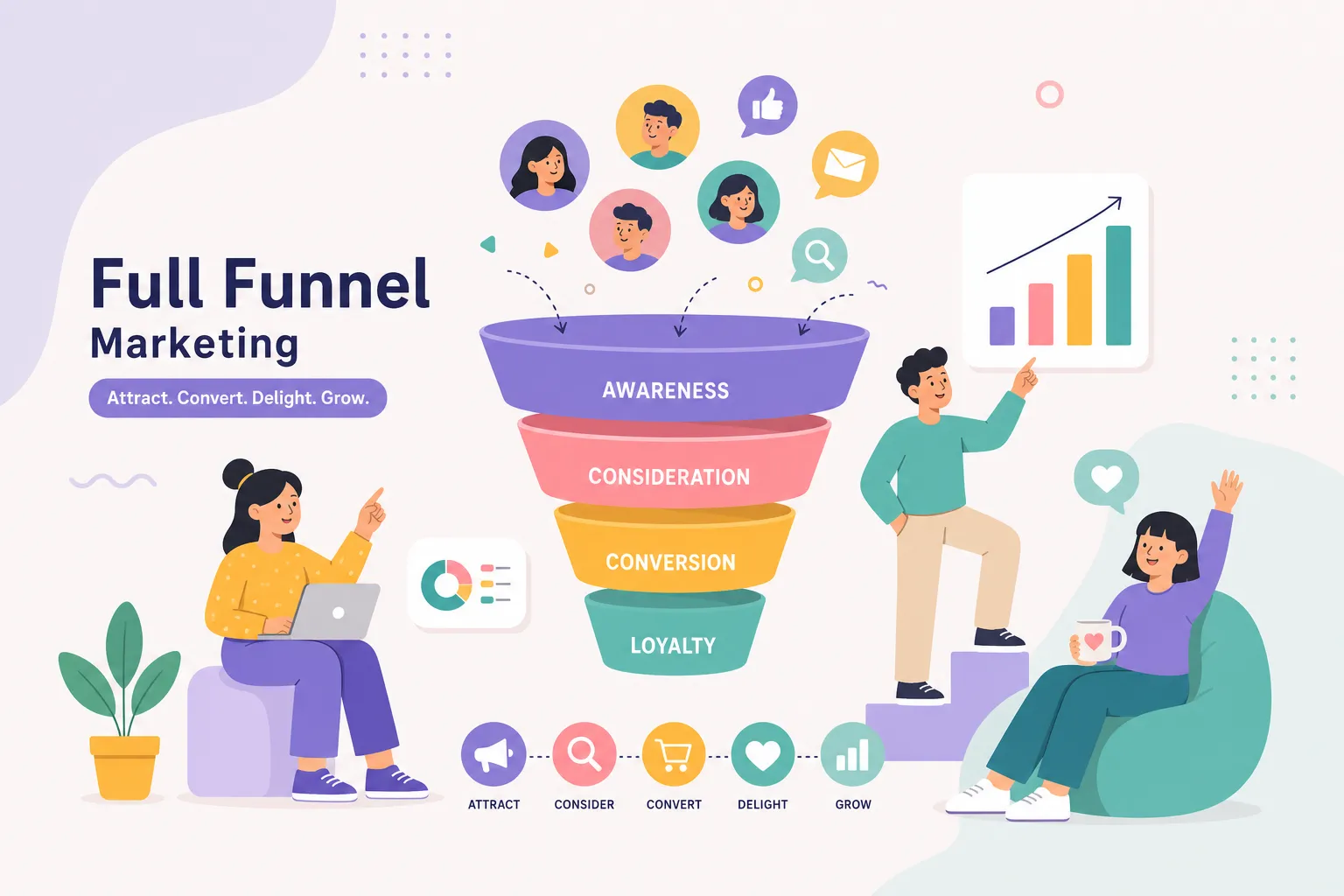
Every buying journey moves through three stages, regardless of industry. At the top of the funnel (TOFU), a prospect becomes aware that a problem exists. They’re not yet looking for your solution; they’re trying to understand the problem itself. The middle of the funnel (MOFU) is where they start evaluating options. They’ve identified the problem, they’re comparing approaches, and they’re looking for proof that one solution is better than the others. At the bottom of the funnel (BOFU), they’re ready to decide. They just need the final reassurance to commit.
Most businesses only invest in one or two of these stages, then wonder why their cost per acquisition keeps climbing. If you’re running paid search ads to a cold audience that has never heard of your brand, you’re asking strangers to buy from a company they don’t recognise yet. The funnel doesn’t start at the sale; it starts at awareness.
The critical shift in 2026 is that brand and performance marketing are no longer separate functions. Awareness campaigns feed conversion campaigns. Content builds the trust that makes paid ads close faster. According to a Google and Nielsen joint study examining more than 1,300 campaigns across roughly 20 brands (published as part of their multi-touch attribution research), full funnel strategies delivered up to 45% higher ROI than conversion-only approaches. That’s not a marginal improvement. It’s the difference between a marketing budget that compounds and one that leaks.
Top of funnel: creating demand with the right awareness channels
TOFU is where you reach people who don’t know you yet. The primary channels for this stage are SEO and blog content for organic problem-aware traffic, YouTube and short-form social video for reach, and Meta or LinkedIn prospecting campaigns for paid awareness. For niche audiences, podcast content and native advertising also have a clear role. The key constraint for smaller businesses is this: don’t spread spend thin across six channels. Pick one or two that reach your audience and execute them properly.
TOFU content educates rather than pitches. A blog post answering a common industry question, a LinkedIn thought-leadership piece, or a short explainer video that frames a problem clearly, these are what build initial brand recognition. The CTA at this stage should be low-friction. “Read more,” “watch the video,” “download the guide” are far more appropriate than “book a call” for someone who encountered your brand thirty seconds ago.
When it comes to budget allocation, the 70/20/10 framework is a useful guide: put 70% of your overall channel budget into proven channels, 20% into growth and test activity, and 10% into experimental tactics. This applies across your full media mix, not solely to awareness formats. At TOFU specifically, it means resisting the temptation to fragment spend across too many new platforms before your core awareness channels are performing consistently.
The metrics that matter at TOFU are impressions, reach, new visitors, share of search, and cost per thousand (CPM). Conversion rate is not the right measure at this stage, and tracking it here creates misleading conclusions. A prospecting campaign reaching cold audiences will never convert at the same rate as a retargeting campaign. Judging awareness activity by conversion rate is how businesses defund the very channels that make every other stage work.
Middle of funnel: turning interest into qualified leads
The middle of the funnel runs on retargeting and email, the mechanisms that follow up with people who showed interest but didn’t take action yet. A retargeting campaign to blog readers, a triggered email sequence after a guide download, a webinar invite to engaged site visitors: these are the core MOFU tools.
Here’s how the sequence works in practice. A prospect reads a TOFU article on choosing a CRM. They enter a short email sequence that delivers a comparison guide on day three and a webinar invite on day eight. By day ten, they’re far more qualified than someone who clicked a cold ad. This is the engine of full funnel advertising, paid and organic working together to move a prospect from curiosity to consideration without forcing the sale.
The assets that work at this stage are downloadable checklists, templates, ROI calculators, comparison guides, and case-study-style content. For UK B2B service businesses specifically, interactive assessments and audits consistently convert at higher rates than static ebooks, in some B2B contexts, interactive formats achieve conversion rates of 35, 50%, because they require the prospect to engage with their own situation rather than simply consume general information. The goal at MOFU isn’t just to capture an email address; it’s to move the prospect toward a decision with evidence that’s relevant to them.
Content personalisation doesn’t need to be complicated. Segment follow-up by industry or role, based on what content the prospect originally engaged with. This makes nurture more relevant and improves the quality of leads reaching your sales team. The MOFU KPIs to track are visitor-to-lead rate, email open and click rates, webinar attendance, and lead quality scoring. Raw lead volume is less useful than the proportion of leads that progress to the next stage, and that ratio is what tells you whether your nurture is working or just generating noise.
Bottom of funnel: converting high-intent prospects
At BOFU, the prospect is comparing you against one or two alternatives. The content that converts here is proof-based: case studies, ROI calculators, testimonials, pricing pages, and free consultations.
Consider this scenario. A lead has visited your pricing page twice but hasn’t booked a call. A retargeting ad offering a free 30-minute strategy session reaches them the following day. That single touchpoint, arriving at the right moment with the right offer, can be the difference between a lost prospect and a closed deal. It works precisely because TOFU and MOFU have already done the heavy lifting.
The channels that work at BOFU are branded paid search (capturing people actively searching your company name), dynamic remarketing, offer-based social ads, and direct outreach in B2B contexts. BOFU spend is typically the most efficient in the funnel because the audience is already warm, but it only works if TOFU and MOFU have done their job first. As an illustrative guideline, BOFU can reasonably represent 40 to 50% of paid spend for a smaller business, even though it reaches the smallest audience. That’s appropriate: high-intent prospects are worth spending more to convert.
The metrics at this stage connect directly to business outcomes: conversion rate, cost per acquisition (CPA), customer acquisition cost (CAC), return on ad spend (ROAS), and sales cycle length. These are the numbers your finance team cares about, which is exactly why they should anchor your whole funnel reporting conversation.
Measuring performance across all three stages
Most analytics tools default to last-click attribution, which credits the final touchpoint and ignores all the awareness and nurture work that made the conversion possible. This leads businesses to defund their TOFU channels because they “don’t convert,” when in reality those channels are the foundation of every sale.
Here’s the distortion in practice. A customer sees a LinkedIn video (TOFU), downloads a guide three days later (MOFU), and then searches for your brand name before booking a call (BOFU). Last-click credits the branded search campaign. The LinkedIn video receives nothing, even though it started the entire journey. Effective omnichannel funnel optimisation requires a measurement approach that reflects the full path, not just the final step.
Three measurement approaches hold up well in a privacy-restricted, cookieless environment. First, server-side trackingcaptures events through your own infrastructure rather than relying on browser pixels, which are increasingly blocked or degraded by privacy controls, this improves data durability and is the first step in rebuilding measurement accuracy. Second, first-party data from logged-in users, CRM records, and consented email activity gives a more complete picture of the customer journey than any third-party cookie ever could. Third, marketing mix modelling (MMM) uses aggregated historical data to estimate channel impact without needing user-level tracking, making it particularly useful for upper-funnel measurement where individual attribution is weakest.
Full funnel marketing strategy: attribution and KPIs
A practical unified KPI framework looks like this:
Awareness: reach, share of search, CPM
- Consideration: qualified traffic, visitor-to-lead rate, lead quality score
- Conversion: CAC, ROAS, conversion rate
- Post-sale: repeat purchase rate, lifetime value (LTV), net revenue retention (NRR)
The goal is one reporting framework that connects brand and performance so no stage is managed in isolation. For a practical starting point, run a 90-day test campaign with defined KPIs at each funnel level. Review the data at day 30, 60, and 90, then optimise the weakest stage rather than guessing. Most businesses discover the weakness isn’t where they assumed it was.
Why most founders don't build this system alone
Building a full funnel marketing strategy requires more than choosing the right channels. It demands a consistent message across every touchpoint, shared data between paid, organic, email, and CRM, and someone responsible for the logic that connects each stage to the next. For most founders running a business day-to-day, that level of coordination requires either a dedicated internal hire or an external team, and most founders have neither.
Full disclosure: UKCV, the agency behind this guide, builds these integrated systems for growing businesses. Bristol-based UK Creative Ventures (UKCV) designs the whole funnel architecture, from awareness strategy and creative production through to lead nurture, conversion optimisation, and performance reporting, in one place, rather than leaving founders to manage a separate SEO agency, a paid ads freelancer, and an email tool that nobody monitors consistently. If you recognise the gap between your current approach and the connected system described in this article, get in touch with UKCV to start the conversation.
The structure is simpler than it looks
A full funnel marketing strategy is not a complicated theory. It’s a sequence: build awareness with the right channels, nurture interest with relevant content and retargeting, then convert intent with proof-based assets and high-efficiency BOFU spend. Measurement ties it together with a KPI framework that tracks performance at every stage rather than just the last click.
The businesses that will grow consistently in 2026 are those that treat marketing as a system, not a series of disconnected campaigns. You now have the structure to build that.
The next decision is which stage to strengthen first. Is your awareness strategy leaking reach before prospects ever reach MOFU? Is your nurture sequence failing to move leads toward a decision? Or is your conversion funnel playbook letting high-intent prospects slip away at the final step? Start there, measure it properly, and build from that foundation.
Tags: