

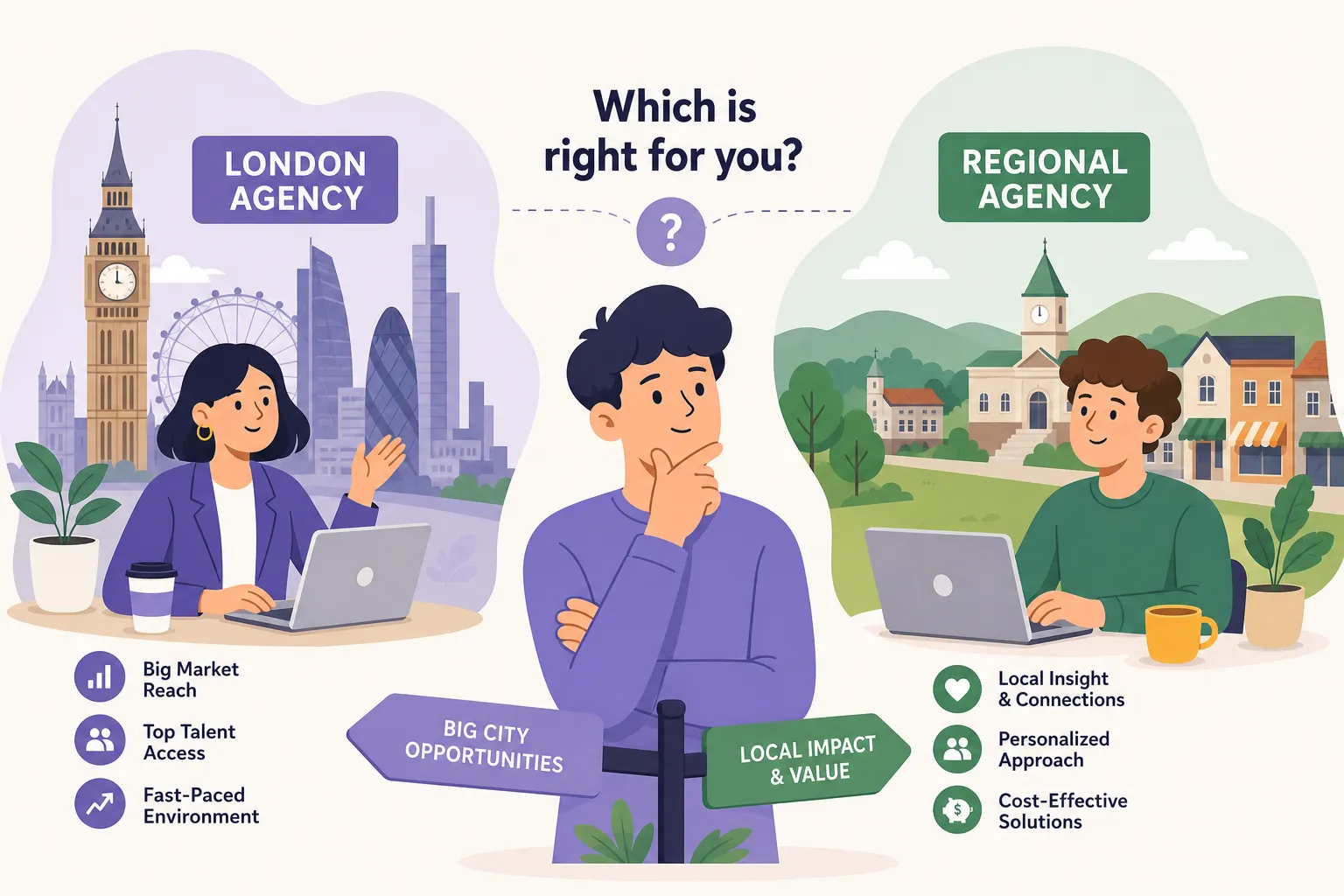
Remote-first delivery is the norm across the UK agency market.
UKCV
London Marketing Agency vs Regional Agency: Which Is Right for You?
Many London SMEs searching for a marketing agency in London start with a geography filter. They want a Shoreditch studio, a roster of recognisable logos on the homepage, and a postcode that begins with EC or W1. It is an understandable instinct, but it can be a costly distraction, one that leads to higher fees without guaranteed better results. The London marketing agency market is vast, competitive, and varied in quality. Premium pricing does not guarantee premium outcomes, and the capital’s overheads are baked into every invoice whether you benefit from them or not.
Meanwhile, regional digital marketing agencies are increasingly publishing case studies showing outcomes on par with London firms, delivered from Bristol, Manchester, Leeds, and beyond. Most client relationships now run on shared dashboards, Slack channels, and monthly video calls regardless of where either party is based. Geography has stopped being the filter it once was. This guide gives you a structured framework to shortlist the right marketing partner for your business in 2026, whether that turns out to be a Soho creative agency or a Bristol-based growth consultancy that does not need a London postcode to deliver exceptional work.
Why the London postcode assumption is costing SMEs money
What the London brand premium actually buys you
There are situations where a London agency’s location genuinely matters. If you are running a large-scale FMCG brand launch, closing enterprise B2B deals that require face-to-face relationship building, or operating in a sector where agency-client introductions happen through City networks, then the London ecosystem has real situational value. For most SMEs, however, the postcode is background noise. It has no bearing on how well an agency plans a paid media campaign, writes a content strategy, or manages your SEO programme.
London agencies carry higher overheads: office rents, senior talent salary expectations, and the general cost of operating in one of the world’s most expensive cities. Those costs feed directly into your monthly retainer. When you pay a London advertising agency £6,000 a month, a portion of that figure commonly reflects higher London operating costs rather than your campaign performance. The right question to ask at the start of your search is not “Are they in London?” but “Can they prove results for businesses like mine?”
When geography stops mattering
Remote-first agency delivery is now the default model across the UK, not the exception. Onboarding happens via video call, strategy is shared through collaborative documents, and reporting lands in your inbox on a fixed schedule, campaign decisions are made asynchronously without anyone needing to be in the same room. The operational difference between working with a London agency and a regional agency is, in most cases, negligible. What genuinely differs is overhead structure, and by extension, what proportion of your budget goes toward your account versus the agency’s running costs.
Regional agencies based in Bristol, Manchester, Leeds, or Birmingham typically carry significantly lower overheads and pass those savings to clients through either competitive pricing or a higher ratio of media spend to management fee. The same SEO methodology, audit framework, and paid media expertise that a marketing agency in London deploys is equally deliverable from outside the capital. Your job is to find the team that can execute it well, not the one with the most impressive postcode.
Matching the right specialisms to your business goals
B2B vs B2C: the channel mix is completely different
Not every agency describing itself as a “digital marketing agency” offers the same capability. B2B buyers respond to LinkedIn campaigns, long-form SEO content, case studies, thought leadership, and account-based marketing. If you are a professional services firm or a SaaS company trying to reach procurement directors, hiring a creative agency built around Instagram campaigns and consumer brand storytelling is a fundamental mismatch. Agencies like Digital Uncut in London are explicitly positioned for B2B search and performance work; agencies like CEEK focus on FMCG and consumer sectors. Both are credible; neither is interchangeable.
B2C and ecommerce businesses need paid social, PPC, and conversion rate optimisation working in tandem, often with strong creative production capability sitting alongside media buying. When you shortlist agencies, ask every candidate to show you sector-relevant experience, not just industry awards or a general portfolio. A logo wall without outcomes attached tells you the client existed; it tells you nothing about the results delivered.
Performance marketing vs brand building: picking your priority
Performance marketing covers SEO, PPC, paid social, and data-led attribution. Results are often measurable within weeks to a few months depending on channel and budget, and they are directly tied to revenue metrics: cost per lead, ROAS, conversion rate, and pipeline value. Brand marketing covers identity, messaging, creative direction, and awareness. It is foundational for long-term growth but slower to measure, and its impact often shows up in performance data months after the work is done rather than immediately.
Most scaling SMEs need a blend of both, but many agencies specialise in one and pay lip service to the other. Before you spend time on discovery calls, decide which capability is your primary need right now. If you are generating traffic but not converting it, you need performance and CRO expertise, if nobody in your target market has heard of you, brand positioning comes first. Clarifying this upfront saves you from hiring a brand agency when what you actually need is a conversion specialist, and vice versa.
What to expect from a marketing agency in London, fees in 2026
Monthly retainers: what the market is charging
Boutique or specialist agencies typically charge between £1,500 and £3,000 per month and usually cover one or two channels with a small team. Established SME-focused agencies sit in the £3,000 to £8,000 range and generally provide multi-channel execution with a dedicated account lead. Full-service retainers covering creative, paid media, SEO, and content running in parallel move into the £8,000 to £15,000 or more bracket. A marketing agency in London at the premium end of that range often reflects higher operating overheads rather than proportionally higher output quality.
For hourly work, senior strategy, creative direction, and specialist consultancy sits between £150 and £200 per hour. Production-level work runs closer to £75 to £100. These figures are a useful benchmark when assessing proposals, but the more important number is always the ratio of what you are paying in fees to what is actually being directed toward media spend and creative production. Ask agencies to break this down explicitly.
Project vs retainer vs hourly: choosing the right model for your stage
Early-stage businesses with a defined, bounded brief, such as a brand identity project or a website launch, are often better served by a project fee. You agree scope, deliverables, and a fixed price, and both parties know what done looks like. Scaling businesses running ongoing paid media, SEO, and content need a retainer with clearly defined deliverables and a monthly reporting cadence. Open-ended retainers without a scope document are where misaligned expectations and wasted budget accumulate.
Hourly arrangements suit specific situations: audits, strategy sessions, or overflow creative work. They rarely provide the accountability or momentum of a retainer because neither party has committed to a sustained outcome. Whatever model you choose, insist on a detailed statement of work before signing anything. Vague contract language is almost always resolved in the agency’s favour when a dispute arises.
How to vet a marketing agency in London, or anywhere
Five questions that expose an agency's real capability
A structured discovery call separates agencies that can think strategically from those that can only present slides. Bring these five questions to every call you run:
- What business outcome are you trying to drive, and how will you measure whether it was achieved?
- What experience do you have with businesses in our sector, and what specific results have you generated?
- What strategy would you recommend for us, and why is that the right approach given our goals and budget?
- Who specifically will be working on our account day to day, and who owns the relationship?
- What happens if we miss targets: what does accountability look like in your model?
The quality of the answers to questions three and five tells you more than any credentials deck. A capable agency will give you a specific, reasoned strategic recommendation in response to question three even at the discovery stage. A weak agency will default to generalities. On question five, any hesitation or vague language about “working together to improve” without a defined accountability process is a signal worth taking seriously.
Case studies, awards, and third-party signals worth trusting
Published case studies with numeric outcomes are the strongest proof of capability available to you. Look for revenue uplift figures, cost-per-lead improvement, ROAS data, or pipeline numbers. Sierra Six Media, for example, publishes a case study showing a 135% revenue increase and a 92% rise in website transactions for a named client. That level of specificity is what you should expect before committing budget, a logo wall without outcomes attached to it tells you the client existed, but says nothing about the results delivered.
B Corp certification is a meaningful governance signal. Several London agencies including 11 London, Nice and Serious, Floom Creative, and Richmond and Towers carry B Corp status, which indicates accountability standards that extend beyond financial performance. Clutch reviews and Google ratings provide useful third-party social proof; check recency as well as volume, since a cluster of five-year-old reviews with nothing recent tells its own story. One more thing: ask any shortlisted agency whether they are tracking how their clients appear in generative AI search environments such as ChatGPT, Perplexity, and Google AI Overviews. It is an emerging capability, but agencies advising on digital visibility in 2026 should at minimum be aware of it.
Contract terms you need to understand before you commit
Notice periods, initial terms, and what's negotiable
Most London marketing agencies use a three to six month initial term with a 30-day rolling notice period once that term expires. Sixty or ninety day notice periods appear in larger engagements but are less common at the SME level. Auto-renewal clauses exist in most standard agency templates; flag these before signing and agree a specific review date in writing. Payment terms are typically net 15 to net 30; anything shorter than 15 days on a retainer should prompt a conversation about cash flow expectations on both sides.
The initial term length is usually negotiable, particularly for smaller retainers. If an agency insists on a 12-month minimum commitment for a boutique-tier engagement, that is worth questioning. Three to six months gives both parties enough time to see meaningful results while limiting your exposure if the relationship is not delivering.
Deliverables, reporting, and what an SLA actually means
Deliverables should appear in a statement of work or service schedule, listed clearly rather than buried in vague master agreement language. Insist on a defined reporting cadence, monthly at minimum, with specific KPIs tied directly to the business outcome you agreed at the start. Reporting transparency is a practical filter during your vetting process: if an agency resists sharing raw channel-level performance data or provides only aggregated summaries, treat that as a red flag. You should always have direct access to the numbers.
Ask the offboarding question before you sign, not when you decide to leave. Who owns the creative assets? Who holds the ad account access? Who controls the domain and any tracking infrastructure built during the engagement? These questions are much easier to resolve contractually upfront than they are to negotiate after a relationship has broken down.
London agency or regional partner: making the final call
How to build your shortlist of three to five candidates
Start with specialism, not location. Filter first by whether the agency has proven experience in your sector and with your business model, whether B2B or B2C, performance-led or brand-focused. Use directories such as Clutch, The Drum, and the Recommended Agency Register alongside direct referrals from your network. Referrals from founders who have used an agency in a context similar to yours carry more weight than any directory ranking.
Aim for a shortlist of three to five agencies that includes a mix of London-based and regional options. The comparison itself is valuable: it forces you to be precise about what you are actually evaluating. When searching for London marketing companies or regional alternatives, send a brief that specifies your goals, your current monthly budget range, and your timeline expectations. Agencies that respond with a generic capability deck rather than a considered reply to your specific brief go to the bottom of the list immediately.
Why the best agency might not have a London postcode
Remote-first delivery is the norm across the UK agency market. Most client relationships, regardless of where the agency sits, are managed digitally through shared reporting tools, regular calls, and direct Slack access to the people working on your account. Regional agencies carry lower overheads and can direct a higher proportion of your budget toward actual media spend and creative production rather than London office costs. That structural advantage compounds over a 12-month engagement.
UK Creative Ventures (UKCV) is a Bristol-based growth agency working with SMEs across the UK on marketing strategy, paid media, specialist recruitment, and AI visibility, without the London postcode premium. If you are comparing a marketing agency in London against regional alternatives, the question that should close your evaluation is not “Are they near us?” but “Can they prove results for businesses like ours?” Apply that filter consistently across every agency on your shortlist, and the right choice becomes significantly clearer.
Choosing a marketing agency in London vs regional firms, checklist
The right marketing agency for your business is the one that matches your specialism needs, fits your budget honestly, can back their claims with published case study evidence, and is willing to work to outcomes rather than just outputs. Location is a factor worth considering during your shortlisting process, but it is rarely the deciding one once you have done the work of properly vetting your candidates.
Define your specialism need before you start calling agencies. Benchmark proposals against 2026 pricing. Run a structured discovery call with the five questions that expose real capability. Review the contract for notice periods, deliverable scope, and offboarding terms before you sign anything. Shortlist agencies, whether you are looking at a marketing agency in London or a regional firm, that have proven they can do what you need, not just promised it on a slide deck. That process, applied consistently, will get you to the right partner faster and with far less wasted time and budget along the way.
If you want help finding the right marketing agency in London or a growth-focused regional alternative, the UKCV teamis worth a conversation. We work with SMEs across the UK and will give you a straight, no-obligation assessment of what fits your goals and budget. Reach out through the marketing services page to get started.
Tags: