

-
2508 Views
The agency retainer makes commercial sense when your team lacks the capacity to manage data pipelines, content strategy, and platform configuration simultaneously.
UKCV
Many UK SMEs are paying for email marketing and getting generic results. Not because their emails are badly written, but often because their tools are doing segmentation rather than personalisation. Segmentation says “send this to everyone who bought in the last 90 days.” Personalisation says “send this specific person, this specific message, at this specific time, based on everything we know about their behaviour.” The gap between those two approaches is measurable in open rates, conversions, and revenue.
Not all AI marketing services that offer personalised email campaigns are built the same way. The options range from native AI platforms like Klaviyo and Braze to full-service agency models where everything is done for you. Choosing the wrong one costs you both time and budget, because switching platforms mid-campaign means rebuilding your data connections, your segments, and your automation logic from scratch.
Businesses that work with a growth partner like UK Creative Ventures (UKCV) before they approach any vendor tend to shortlist more efficiently. The reason is straightforward: they already have a clear view of their data maturity and growth stage before they start comparing features, a company claim based on UKCV’s working process with UK SMEs. This guide covers what separates AI email personalisation from standard ESP capabilities, the leading platforms, realistic ROI benchmarks, pricing models, data requirements, and how to make the final call.
What AI personalisation actually does to your email campaigns
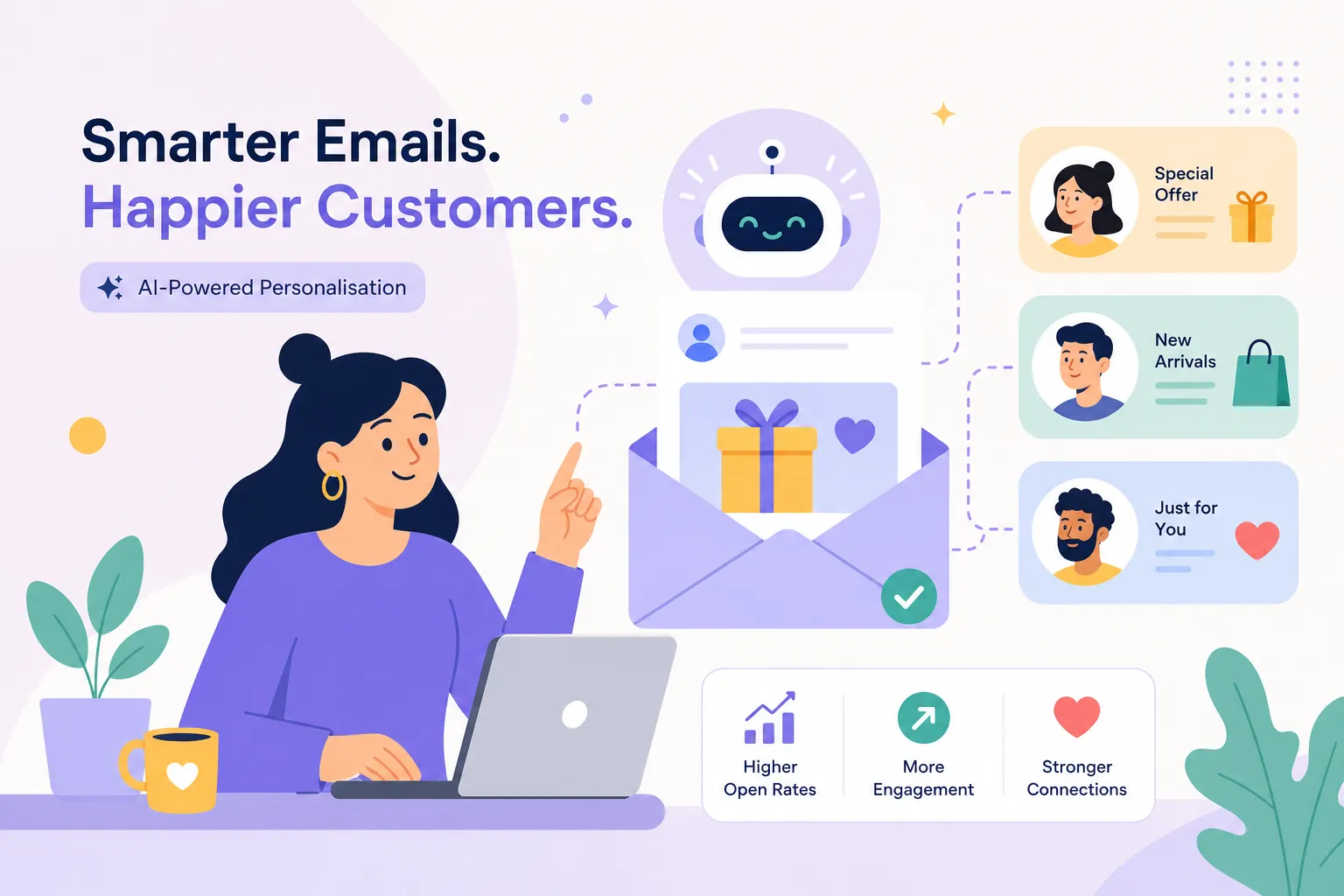
Four features define AI-powered email personalisation: dynamic content blocks, subject-line optimisation, predictive send-time optimisation, and recommendation engines. Dynamic content changes the email body, images, and calls to action for each recipient based on their behaviour, not just their segment. Two subscribers on the same list can open entirely different emails because one browsed running shoes last week and the other hasn’t visited the site in 30 days.
Subject-line optimisation uses generative AI email marketing tools to produce or test variations based on what is most likely to drive an open for that specific recipient, rather than running a generic A/B test across your whole list. Send-time optimisation predicts the best moment to deliver the email based on each person’s past engagement patterns. Recommendation engines pull in product or content suggestions based on purchase history and behavioural signals, so the email feels less like a broadcast and more like a conversation. Unlike standard ESPs, which typically apply these features at the segment level rather than the individual level, dedicated AI email personalisation platforms apply them per recipient.
These features compound over time. Send-time optimisation becomes more accurate after four to six weeks of engagement signals. Recommendation engines need depth in purchase history to make reliable predictions. Dynamic content requires consistent event tagging across your site and app. This is why businesses that launch AI email tools with weak data infrastructure see modest results and blame the platform, when the real constraint is the data sitting underneath it.
AI marketing services that offer personalised email campaigns: the leading platforms
Klaviyo is the clearest starting point for most UK SMEs looking at AI email personalisation platforms. AI personalisation is built into the core product rather than added through a third-party connection. You get native send-time optimisation, predictive segmentation, AI-assisted content generation, and product recommendation logic without building a separate integration stack. The Segments AI feature has no stated minimum list size, though send-time optimisation requires at least 12,000 recipients to run reliably. For most growing ecommerce or DTC businesses, Klaviyo covers the majority of personalisation use cases without requiring a CDP layer from day one.
Mid-market and enterprise options
Braze and Bloomreach serve more complex needs. Braze handles high-volume, cross-channel personalisation with strong dynamic content and send-time capabilities across email, push, and in-app messaging. Bloomreach positions itself as a marketing CDP as well as an email platform, which suits businesses that want to consolidate their personalisation engine and their data layer under one vendor. Both are stronger fits for mid-market and enterprise teams with dedicated technical resource to manage implementation.
CRM-embedded personalisation and ESP integrations for AI personalisation
HubSpot and Salesforce both include AI personalisation features, but those features live inside broader CRM and marketing suites rather than being the primary product focus. If your business is already embedded in one of those ecosystems, the AI email capabilities are worth exploring. Be aware that advanced personalisation in both platforms can often require additional configuration and integration work compared with Klaviyo’s more self-contained approach, which can add to onboarding time and cost, a comparison based on vendor documentation and third-party platform reviews rather than direct independent testing.
Some businesses use a standard ESP like Mailchimp or Campaign Monitor and layer AI personalisation through a third-party tool or CDP. This approach works, but it adds complexity. You are managing two vendors, two data pipelines, and two sets of event schemas. It is worth knowing that option exists, but it is rarely the most efficient path for an SME that does not already have a data engineer on the team. This is precisely the scenario where a personalised email automation provider that handles both the platform and the data layer under one engagement tends to deliver faster results.
ROI benchmarks worth knowing before you commit
Vendor-reported results from UK-focused AI email providers, including Republic Marketing and Emailmovers, show open rates running 20 to 30 per cent above industry benchmarks when AI personalisation is implemented correctly. These are provider-reported figures from a limited sample, so treat them as directional rather than definitive. For AI-personalised B2B email campaigns, CTR improvements of around 30 per cent are cited by providers such as Emailmovers working in that space; again, these are provider-reported claims rather than independently verified benchmarks. Some agencies report broader outcomes like 400 per cent increases in lead generation over 90-day periods, though those figures typically reflect the combined impact of list quality, offer quality, and AI personalisation working together rather than the AI layer alone.
For context, UK B2B email benchmarks in 2026 sit around 18 to 25 per cent open rate and 2.5 to 4.0 per cent CTR for most industries. UK B2C benchmarks show roughly 21 to 31 per cent open rates and 1.7 to 3.4 per cent CTR depending on sector and list quality. The honest expectation is that well-executed AI-personalised campaigns should consistently sit at the upper end of those sector benchmarks, not at some entirely separate level of performance.
For SMEs implementing AI email for the first time, expect measurable open rate improvement within four to eight weeks as send-time models accumulate data. Full personalisation effects on conversion typically become visible in the 90-day window. One honest caveat: early gains are often driven by list hygiene improvements and stronger offer clarity that happen during platform setup. Attributing all of that to the AI layer is a mistake that leads to unrealistic expectations when you scale.
Pricing reality: SaaS platforms vs. agency-run services
Self-serve SaaS platforms are priced on a contact or active-profile basis. Entry tiers for platforms like Klaviyo start at approximately $15 to $55 per month for smaller lists, with mid-range plans running from roughly $70 to $200 per month. Higher-volume or enterprise plans typically sit at $300 or more per month. (GBP equivalents will vary with current exchange rates, check vendor UK pricing pages for the latest figures.) The key watch-out is that contact-based pricing scales sharply as your list grows, so list hygiene is not just a performance issue but a direct cost issue.
Agency-run AI-personalised email services are sold as monthly retainers, typically in the range of $2,500 to $12,000 or more per month for done-for-you services, based on USD-denominated agency rate cards, UK agency pricing will vary. The higher end of that range covers multi-channel complexity, full data pipeline management, and content strategy. Boutique email-focused agencies often sit at the lower end of that spectrum. Most mid-range retainers include platform management, monthly content production, performance reporting, and ongoing audience segmentation refinement.
The agency retainer makes commercial sense when your team lacks the capacity to manage data pipelines, content strategy, and platform configuration simultaneously. Smaller teams frequently get faster time-to-result through an agency than through a self-serve platform they configure at 60 per cent of its capability. The question is not which model is cheaper in isolation; it is which model gets the AI features actually working correctly for your specific data setup and growth stage.
Data and setup requirements before you go live
AI email personalisation is only as good as the data feeding it. The practical minimum for most platforms includes 90 days of behavioural and transactional history, at least 10 tracked events per user, consistent event naming across all channels, and real-time or near-real-time CDP sync to your email platform. The key data types are website behaviour, email engagement history, purchase or revenue data, CRM lifecycle fields, and zero-party preference data collected directly from subscribers.
Inconsistent event naming is one of the most common failure points. If your site fires a “product_viewed” event and your app fires a “view_product” event, your CDP cannot unify those signals into a coherent behavioural profile. Identity stitching across devices and email addresses is equally important. One person should not appear as three separate profiles because they used a different device each time. Clean data architecture before you select a platform will save you weeks of remediation work after launch.
Onboarding timelines depend on data readiness. A 30-day deployment is achievable when your data is reasonably clean, your integration scope is narrow, and you are starting with one or two personalisation use cases rather than the full stack. A 12-week phased build is the more realistic timeline for businesses that need to address data hygiene, identity resolution, or multi-channel event tracking as part of the project. That phased approach typically covers data foundation work first, then expansion to additional use cases, and finally performance optimisation.
Choosing AI marketing services that offer personalised email campaigns: five questions to ask first
Before committing to any platform or agency, get clear answers to these five questions:
- Does the platform support native AI personalisation, or does it require third-party integrations to deliver the features you need?
- What is the minimum data volume required for the AI features to work effectively, not just to activate?
- What does onboarding support include, and what costs extra?
- How does pricing scale as your contact list grows?
- Can they show verifiable results from businesses at your revenue stage and in your sector?
The answers to those questions will quickly separate platforms that suit your current data maturity from those that require infrastructure you do not yet have. A platform with powerful AI features is not the right choice if your event data is inconsistent and your CDP sync is running on a 24-hour delay.
At UK Creative Ventures (UKCV) , we work with UK SMEs and startups to assess data maturity first, then recommend the right platform for their stage and budget. We manage implementation so that the AI features are configured correctly from day one rather than sitting unused because setup was never completed properly. Businesses already working with UKCV on their wider digital marketing strategy typically move from platform shortlist to live campaigns more efficiently, because the data infrastructure and audience strategy are already in place before any vendor conversation begins.
The decision comes down to data readiness and team capacity
The right AI email personalisation tool is the one your data is ready to support and your team has capacity to operate correctly. Native AI platforms like Klaviyo are the clearest starting point for most UK SMEs, offering built-in send-time optimisation, predictive segmentation, and product recommendation without requiring a separate CDP layer from day one. Realistic ROI shows up in open rates within four to eight weeks with proper setup. Data quality matters more than platform choice every single time.
Choosing AI marketing services that offer personalised email campaigns ultimately comes down to matching platform capability to your current data maturity and team capacity, not chasing the most feature-rich option on the market. If selecting and configuring an AI-powered email marketing stack feels like a distraction from the growth work your business needs to prioritise, a specialist partner removes that decision overhead and gets you to measurable results faster. If you want to understand how this fits into a broader digital marketing strategy built for your stage, explore how UKCV approaches marketing for growing UK businesses.
Tags: