

-
2009 Views
The most common mistake isn't picking a bad channel. It's picking a channel without running it through three basic filters first: audience fit, budget reality, and time-to-results tolerance.
UKCV
What digital marketing channels work best for early-stage startups? It’s one of the most consequential questions a founder can ask, and one of the most commonly answered badly. Many founders choose their channels based on what they’ve seen another startup do. The problem is that what worked for a funded B2B SaaS in London won’t necessarily work for a bootstrapped e-commerce brand in Bristol. Copying someone else’s channel mix is a resource allocation problem, not a creativity problem, and it’s a frequent reason founders burn through their first year of marketing budget without meaningful results.
This article gives you a channel-by-channel breakdown of what actually delivers early traction, what it costs in the UK, and how long you should realistically wait before expecting results. It also walks you through a 90-day test plan so you stop guessing and start measuring. For founders who’d rather not piece together a team of specialists, Bristol-based UK Creative Ventures (UKCV) works with early-stage teams to map and prioritise their channel mix from day one, without the overhead of building an in-house marketing function.
Why most early-stage startups pick the wrong channels first
The most common mistake isn’t picking a bad channel. It’s picking a channel without running it through three basic filters first: audience fit, budget reality, and time-to-results tolerance. Skip any one of these and you’ll likely end up either reaching the wrong people, running out of budget before you get meaningful data, or pulling the plug on a channel that simply needed more time.
Audience fit asks whether your target customer is actually reachable and persuadable on this channel. Budget reality asks whether you can sustain the channel long enough to generate a signal worth acting on. Consider a B2B SaaS startup with £3,000 per month in marketing budget, that’s unlikely to stretch across LinkedIn Ads and paid search simultaneously without both efforts becoming too thin to draw conclusions from. Time-to-results tolerance is about your runway: if you have six months of cash, a slow-burn SEO play isn’t your primary acquisition channel right now.
Channel decisions should come from these filters, not from what a founder you admire mentioned in a podcast. Time-to-first-customer varies significantly by channel: cold outreach can produce results in days, SEO typically takes three to six months, and paid ads generally require around three to four months before producing a reliable customer flow in early-stage accounts, though this varies by sector and spend level. Knowing this upfront changes how you allocate your budget.
What digital marketing channels work best for early-stage startups?
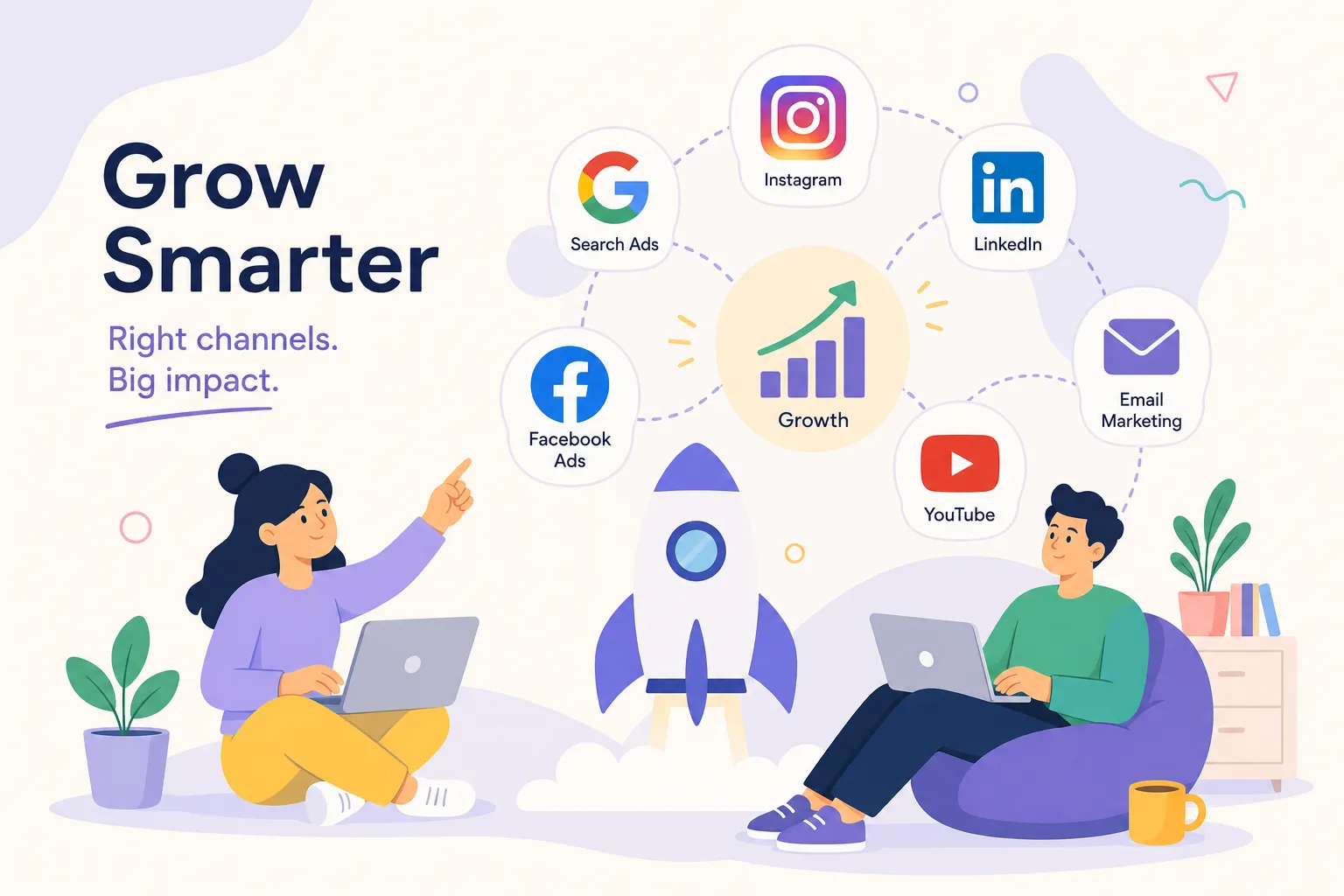
There are four channels worth understanding in detail. Not because you should run all four, but because knowing what each one is actually good for helps you make a rational choice rather than a familiar one. These are the channels with the strongest early-stage track record across UK startups, and the ones that consistently appear in channel prioritisation decisions for early-stage teams.
SEO and content: slow to start, strong over time
Organic search is one of the most reliable acquisition channels over time, but it requires patience. Most early-stage SEO campaigns don’t generate meaningful traffic for three to six months, and the first work looks unglamorous: fixing technical foundations, building keyword-clustered content, and earning relevant links. A UK SaaS startup that committed to a content-led SEO strategy increased organic traffic by more than 1,100% over 18 months and reduced blended customer acquisition cost by 60%, according to the Studio.351 case study. That outcome doesn’t happen in quarter one, but it compounds in ways paid channels don’t. SEO suits founders with longer runways, content-capable teams, or an agency handling execution.
Paid search and paid social: speed and signal
Paid ads give you the fastest feedback on messaging and audience fit, which is genuinely valuable early on even if the CAC is higher. Based on 2026 UK benchmark data, Google Search CPC ranges from around £0.92 for e-commerce to £3, £8 for B2B SaaS on core terms, with conversion rates between 1.65% and 4.21% for SaaS and B2B search campaigns. Meta CPM for B2B audiences in the UK runs around £18, making it a more expensive channel for cold B2B acquisition than many founders expect.
The strategic logic here matters and is worth separating clearly. Paid search captures existing demand from people already searching for a solution. Paid social creates or retargets demand from people who aren’t searching yet. For early-stage B2B startups, paid social works best as a testing and retargeting layer rather than a cold-acquisition primary channel, a distinction that shapes how you budget across the two.
Email: the highest-ROI channel most founders underuse
Email is consistently underrated by early-stage teams because it doesn’t feel like “marketing” in the traditional sense. UK startup email benchmarks show newsletter open rates typically sitting between 20% and 30%, while triggered onboarding flows average around 45% open rates and 16% click-through rates. That gap isn’t a coincidence: onboarding emails reach people at the moment of highest intent. Treat email as an activation and retention channel from day one, not just a nurture tool. The cost is low, the controllability is high, and a well-built onboarding sequence frequently outperforms cold channels on conversion, often more so than cold-traffic landing pages with paid spend behind them.
B2B and B2C startups have genuinely different channel logic, and conflating them leads to misallocated budget. Understanding which side of that divide you sit on should be one of the first things you establish before committing to any channel.
For B2B startups, longer sales cycles mean content and email do the work of building trust over time. Paid search captures high-intent decision-makers who are already evaluating solutions. LinkedIn Ads work for enterprise targeting but carry CPMs that make them difficult to sustain on a lean budget. For a B2B HR technology startup targeting HR directors at mid-sized companies, a combination of comparison and case-study content for organic search, paired with a tight paid search campaign on high-intent terms, is a more defensible starting point than running LinkedIn Ads at scale from day one.
For B2C and e-commerce startups, Meta and Google Shopping offer faster feedback loops. Email becomes critical for repeat purchase and lifetime value. SEO tends to pay off faster when search volume is higher and commercial intent is clearer. A direct-to-consumer skincare brand should prioritise Meta prospecting for top-of-funnel reach, email automation for repeat purchase, and product-led SEO content for organic acquisition, rather than pursuing LinkedIn or cold outreach.
Budget stage also shapes the decision. Bootstrapped teams with under £2,000 per month in marketing spend should focus on one or two channels maximum, with organic content and email as lower-cost starting points. Seed-funded teams working with £5,000 to £20,000 per month can introduce paid channels as a testing and scaling layer once their messaging is proven. At Series A and beyond, channel diversification makes sense, and budget allocation should follow CAC data rather than assumptions. Revisit your channel mix every quarter as data accumulates.
What to budget and how long before you see results
Vague estimates aren’t useful when you’re building a plan. Below are UK-grounded CAC benchmarks for startups and channel cost ranges worth working with.
- SEO: An agency-managed retainer typically runs between £500 and £3,000 per month for early-stage startups, with three to six months before you see meaningful organic traffic.
- Google Search: Expect CPC between £0.92 and £8 depending on sector, with conversion rates between 1.65% and 4.21% for SaaS and B2B.
- Meta Ads: CPM ranges from around £4 for broad consumer audiences to £18 for B2B targeting, with faster creative feedback but lower direct conversion for cold B2B traffic.
- Email: Low direct cost once your list exists; onboarding flows average 45% open rates and 13, 16% click-through rates.
- Webinars and partner events: UK events run roughly £2,000, £10,000 all-in per event (excluding internal time costs), with attendance-to-lead conversion typically between 20% and 40% and an estimated cost per lead of around £58, £100.
On CAC: blended CAC is total marketing spend divided by new customers acquired, and early-stage CAC is almost always higher than mature-stage CAC. That’s expected. Brand trust is lower, landing pages are less optimised, and retargeting pools are thin. The danger is pulling a channel too early, six weeks on SEO gives you no meaningful signal. The same logic applies to paid campaigns with thin budgets. Spend enough, wait long enough, and measure the right things before drawing conclusions.
Building a 90-day channel test plan
A structured test removes the guesswork and gives you data you can actually act on. This is an early-stage marketing test plan you can implement immediately.
Pick no more than two channels based on the three filters: audience fit, budget reality, and time-to-results tolerance. Running three or four channels simultaneously on a limited budget means all of them are underfunded and none of them produce a clean signal.
For each channel, define a hypothesis before you start. For example: “If we run LinkedIn Lead Gen ads targeting HR directors with a free audit offer, we expect 20 leads at £150 CPL within 90 days.” That gives you a benchmark to measure against, not just a vague sense of whether it “worked.”
Set a minimum viable spend and time window before drawing conclusions. For paid channels, commit to at least 30 days and £1,000 (treat this as a practical minimum rather than a universal threshold, some sectors will require more) before reviewing. For organic channels, the minimum meaningful window is 90 days. Document your baseline metrics before you launch anything.
The KPIs that actually tell you whether a channel is working are: cost per lead, customer acquisition cost, email reply rate or click-to-activation rate, time-to-first-conversion, and MQL-to-customer rate for B2B. The vanity metrics to ignore early on are impressions, reach, and follower count. Build a simple 30/60/90 checkpoint system:
- At 30 days: review data quality and whether you’re tracking the right things.
- At 60 days: assess whether you’re on track to hit your hypothesis projections.
- At 90 days: make a clear decision to continue, adjust, or cut.
Cut signals include: CPL is consistently three times your target, conversion data is flat after 60 or more days, and the channel isn’t reaching your actual buyers. Double-down signals include: CAC is improving week on week, conversion rate is above sector benchmark, or organic content is producing inbound leads without additional spend. Channel decisions should be data-driven, not comfort-driven. Familiarity with a channel is not a reason to keep funding it.
Frequently asked questions: choosing channels for early-stage startups
What digital marketing channels work best for early-stage startups with a small budget?
For lean marketing on a tight budget, email and organic search offer the strongest return relative to spend. Email has near-zero cost once a list exists, and SEO compounds over time without ongoing spend per click. Paid search can work at small budgets if you’re targeting very specific high-intent terms, but you’ll need at least 30 days and £1,000 committed before the data is meaningful.
How do paid vs organic channels compare for early-stage startups?
Paid channels give you faster feedback, sometimes within days, but the cost per acquisition is higher early on and the results stop when the spend stops. Organic channels take longer to produce results (three to six months for SEO is typical) but build compounding value over time. The practical answer for most early-stage teams is to lead with organic and email, then layer in paid once messaging is validated.
When should an early-stage startup hire a marketing agency?
When the cost of internal trial and error exceeds the cost of structured external guidance. For most early-stage founders, that point arrives before they realise it. A growth-focused agency like UKCV can help you prioritise channels, set up tracking correctly, and avoid the most common allocation mistakes before they compound.
The simplest way to stop wasting your marketing budget
The right channels for early-stage startups are the ones that match your audience, budget, and time-to-results tolerance, not the ones that worked for a different business at a different stage. SEO, email, paid search, and paid social each have a place. Trying to run all four simultaneously with a limited budget is one of the most reliable ways to waste your first year of marketing spend. Channel prioritisation for startups isn’t about doing more, it’s about doing fewer things with enough conviction to get a real signal.
Pick two channels. Test them properly with a clear hypothesis, a minimum spend commitment, and a 90-day window. Measure CPL, CAC, activation rate, and early retention. Make a clear decision at 90 days based on what the data shows, not what feels comfortable.
If you want structured guidance on building and prioritising your channel mix without piecing together a team of specialists, UK Creative Ventures works with early-stage founders to get the foundations right before scaling spend. Get in touch through the marketing services page to start the conversation.
Tags: