

-
2360 Views
No single platform responds to identical signals, which means brand discoverability in AI requires a multi-source strategy, not a single-channel fix.
UKCV
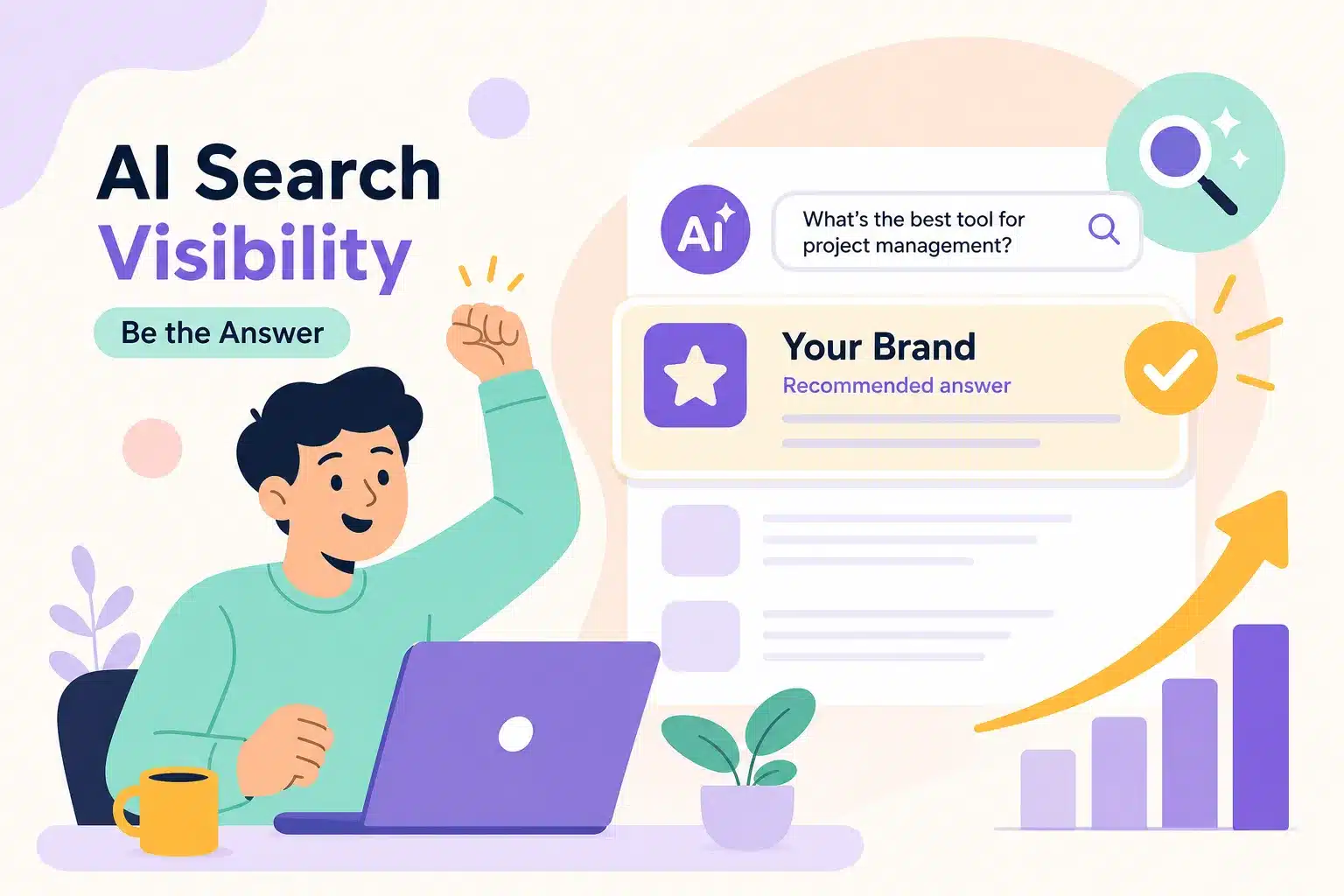
A potential customer opens ChatGPT and types: “Who are the best [your service] providers in the UK?” Your brand doesn’t appear. Not for lack of product quality or reputation, but because the AI has no reliable signal to trust or cite you. Understanding how to win brand visibility in AI search is now one of the most consequential gaps in UK marketing, and most businesses have no idea it exists.
Winning brand visibility in AI search in 2026 isn’t about gaming a new algorithm. It’s about making your brand legible, trustworthy, and citable to systems that retrieve and synthesise information in ways that classic search engines never did. A May 2026 audit examining AI citation patterns among UK businesses found fewer than 5% of SMEs had taken any deliberate action to improve their AI search visibility, a significant opening for businesses prepared to move first.
Forward-thinking agencies, including UK Creative Ventures (UKCV) in Bristol, now offer structured AI visibility audits that benchmark how brands appear across ChatGPT, Gemini, and Perplexity. Structured AI visibility audits, benchmarking how a brand appears across those platforms and identifying citation gaps, are now a distinct service category in the UK market. This article covers the five things that actually move the needle: technical signals, content structure, third-party citations, data governance, and measurement.
Why AI citation logic is nothing like traditional SEO ranking
The first thing to reset is your mental model. AI search tools don’t rank pages the way Google does. They retrieve candidate sources, score them for evidence quality, and filter by structural trust thresholds. The result is that a brand can sit on page one of Google and still be completely invisible in AI-generated answers and AI-driven SERPs alike.
How each platform selects what to cite
Citation patterns vary meaningfully by platform. Analysis of ChatGPT outputs in 2026 found Wikipedia accounted for 47.9% of top-10 source share, with listing platforms making up a substantial additional portion. Google’s AI Overviews distribute citations more broadly, Reddit at 21%, YouTube at 18.8%, and LinkedIn at 13%. Perplexity runs live web searches and weights freshness heavily, meaning recently updated, well-structured pages get preferential pickup. No single platform responds to identical signals, which means brand discoverability in AI requires a multi-source strategy, not a single-channel fix.
The gap between page-one rankings and AI citations
A traditional SEO ranking is earned by relevance, authority, and backlinks. An AI citation is earned by machine-readability, corroboration, and entity recognition. AI systems aren’t visiting your page the way a human reader does; they’re extracting structured evidence. If that evidence is hard to extract, absent from trusted third-party sources, or inconsistently described across the web, your brand gets skipped. Understanding that distinction, and the knowledge graph logic behind it, is the foundation for everything that follows.
How to win brand visibility in AI search: the technical foundation
Structured data is the fastest way to give AI systems unambiguous signals about who you are and what you do. It won’t guarantee a citation on its own, but without it, you’re asking AI platforms to infer information they could otherwise read directly from your pages.
Which schema types matter most for AI search optimisation
The core schema types for AI legibility are Organisation (with name, url, logo, sameAs , description, and contactPoint fields), LocalBusiness for location-based businesses, FAQPage for surfacing direct answers, and Article or BlogPosting with author and publisher attribution.
FAQPage schema has the most documented influence on AI citation selection, particularly for Perplexity and Google AI Overviews, because it presents information in a format AI systems can extract immediately. Organisation schema does the foundational identity work, telling AI platforms what the business is, what it does, and where it has been verified.
Entity consistency: the signal most brands overlook
AI systems resolve brand entities by cross-referencing signals from multiple sources. If your business name, address, phone number, and category description differ between your website, Google Business Profile, LinkedIn page, and Wikidata entry, the AI’s confidence in that entity drops. The specific fields that need to match are your canonical business name, service category, location data, and leadership information. The sameAs property in your schema is the technical mechanism that tells AI systems all these profiles describe the same entity. Implementing it correctly is one of the quickest wins available and costs nothing beyond an hour of careful attention.
Content structured for AI extraction, not just human readers
Most content fails a straightforward test: can an AI system extract a direct, citable answer from this page in under a second? If the answer is buried in a long paragraph, surrounded by marketing language, and unaccompanied by supporting data, it won’t be cited, regardless of how well the page ranks in traditional search.
Answer-first writing and semantic completeness
Answer-first writing means leading every page or section with a concise, direct statement that answers the likely query, then following with context and supporting detail. Use descriptive headings that signal intent clearly, include short “what, why, how” blocks, and provide scannable summaries at natural breakpoints. LLM answer optimisation rewards semantic completeness: AI systems favour content that covers the full scope of a topic coherently over content that simply repeats a keyword. Think about what a knowledgeable person would want to know about the topic, and structure the page to address that fully.
Original research and data as citable assets
AI platforms favour content that contains facts, statistics, and benchmarks that can be quoted directly. Original research, practical guides with specific figures, and fact-dense comparison content give AI systems something citable they can’t easily find elsewhere. If your content contains a unique data point, a sector benchmark, or a documented finding, AI systems are more likely to surface it when users ask open-ended questions in that category. That’s conversational search visibility earned through substance, and it compounds over time as more platforms reference the same source.
Earning citations from trusted third-party sources
Owned content alone won’t deliver AI visibility. AI platforms corroborate brand claims using external sources, and the weight given to those sources varies significantly by platform. This is where most UK businesses have the largest gap.
Which third-party sources carry the most weight by platform
For ChatGPT-style outputs, Wikipedia, established industry directories, and review platforms such as G2, Capterra, and Trustpilot carry the most weight, alongside high-authority editorial coverage. For Google AI Overviews and Gemini, Reddit, YouTube, LinkedIn, and trusted trade publications are disproportionately cited. For Perplexity, freshness and retrievability from any credible source matter most, meaning recently updated directory listings and active editorial coverage perform well. UK businesses should treat Google Business Profile, Bing Places, LinkedIn, Yell, Trustpilot, and one or two sector-specific directories as a non-negotiable Tier 1 priority.
A practical approach to building consistent brand mentions
Think of this as earning corroboration, not link-building. The goal is for multiple trusted sources to describe your brand consistently, giving AI systems reason to trust what your own website says. A prioritised action list looks like this:
- Audit existing listings and directory profiles for accuracy and consistency
- Contribute expert commentary to relevant industry publications, even short quotes in trade press count
- Create or update a Wikidata entry for the brand if it qualifies
- Encourage verified customer reviews on sector-relevant platforms
- Maintain an active LinkedIn company page with structured, keyword-rich service descriptions
Governing brand data so AI platforms get consistent signals
Most AI visibility problems aren’t caused by a lack of content. They stem from inconsistent or stale data spread across too many sources with no one accountable for keeping it aligned. The fix is operational, not creative.
Establishing a single source of truth for business information
A single master record for the brand’s canonical name, service descriptions, founding date, location, leadership, and category feeds everything else. In practice, this means designating one internal owner for business data accuracy and setting a review cadence appropriate to each data type. Operational data such as opening hours may need near-real-time updates; company descriptions and service categories warrant a quarterly review. If the website uses one name format, the Google Business Profile uses another, and LinkedIn uses a third, AI systems face genuine ambiguity about whether these are even the same entity.
Synchronising across GMB, Wikidata, directories, and publisher metadata
The specific platforms that feed AI knowledge systems are Google Business Profile, Wikidata, structured data on your website, LinkedIn, and industry-specific directories. The sameAs property connects these profiles at the technical level. Beyond that, the work is operational: monitor third-party listings periodically for stale information, update descriptions when services change, and flag outdated citations on platforms you don’t directly control. UKCV’sAI visibility auditincludes an entity consistency check across exactly these sources, giving UK businesses a practical starting point for identifying gaps before investing time fixing the wrong things.
How to win brand visibility in AI search: measuring success
You can’t manage what you can’t measure, and AI search visibility is no exception. The measurement framework is straightforward once you know what to track, and it translates clearly into terms a business owner or board can act on.
The KPIs that actually capture AI citation performance
The core metrics are: answer inclusion rate (how often the brand appears across a fixed prompt set), citation rate (how often it is named or linked as a source), share of voice versus named competitors, sentiment and framing (is the brand recommended positively, neutrally, or as an afterthought), and referral traffic from AI platforms tracked in GA4.
Tracking starts with building a prompt set of 20 to 40 queries a real customer might ask, then running them across ChatGPT, Gemini, and Perplexity on a consistent cadence. Tools including Semrush’s AI Visibility Toolkit, Brand Radar, Otterly AI, and SE Ranking now offer structured tracking for these metrics across the main platforms, removing the need to do this entirely by hand.
Auditing your current AI visibility as the starting point
Before prioritising any of the strategies above, a brand needs to know where it currently stands. A structured AI visibility audit covers prompt testing across platforms, citation source analysis, entity consistency checks, schema audits, and competitor share-of-voice benchmarking. That baseline is where meaningful improvement begins, because without it, you’re allocating time and budget to changes you can’t yet evaluate. UKCV’s AI visibility audit is built around exactly this framework, giving UK businesses a documented starting point before committing resource to any of the steps above.
Start with clarity, then build from there
Brand visibility in AI search doesn’t happen by accident, and it won’t come from applying old SEO instincts to a new environment. The brands showing up consistently in ChatGPT, Gemini, and Perplexity answers are the ones that have made themselves machine-readable, externally corroborated, and consistently described across multiple sources.
Knowing how to win brand visibility in AI search comes down to five clear steps: get the technical foundation right with schema and entity signals, structure content for AI extraction rather than just human readers, earn third-party citations from the sources AI platforms actually trust, govern your brand data so every platform sees consistent information, and measure progress with the right KPIs. None of these steps is particularly complicated in isolation. The challenge is doing them systematically rather than sporadically.
If you’re unsure where your brand currently stands across these dimensions, an AI visibility audit gives you a clear baseline showing exactly where the gaps are. Start there before committing budget or time to anything else. UKCV’s AI visibility audit is designed precisely for that starting point.
Tags: