

-
1638 Views
The best agencies for scaling small businesses think about the whole business system, not just individual campaigns.
UKCV
How to choose the best marketing agency for small businesses
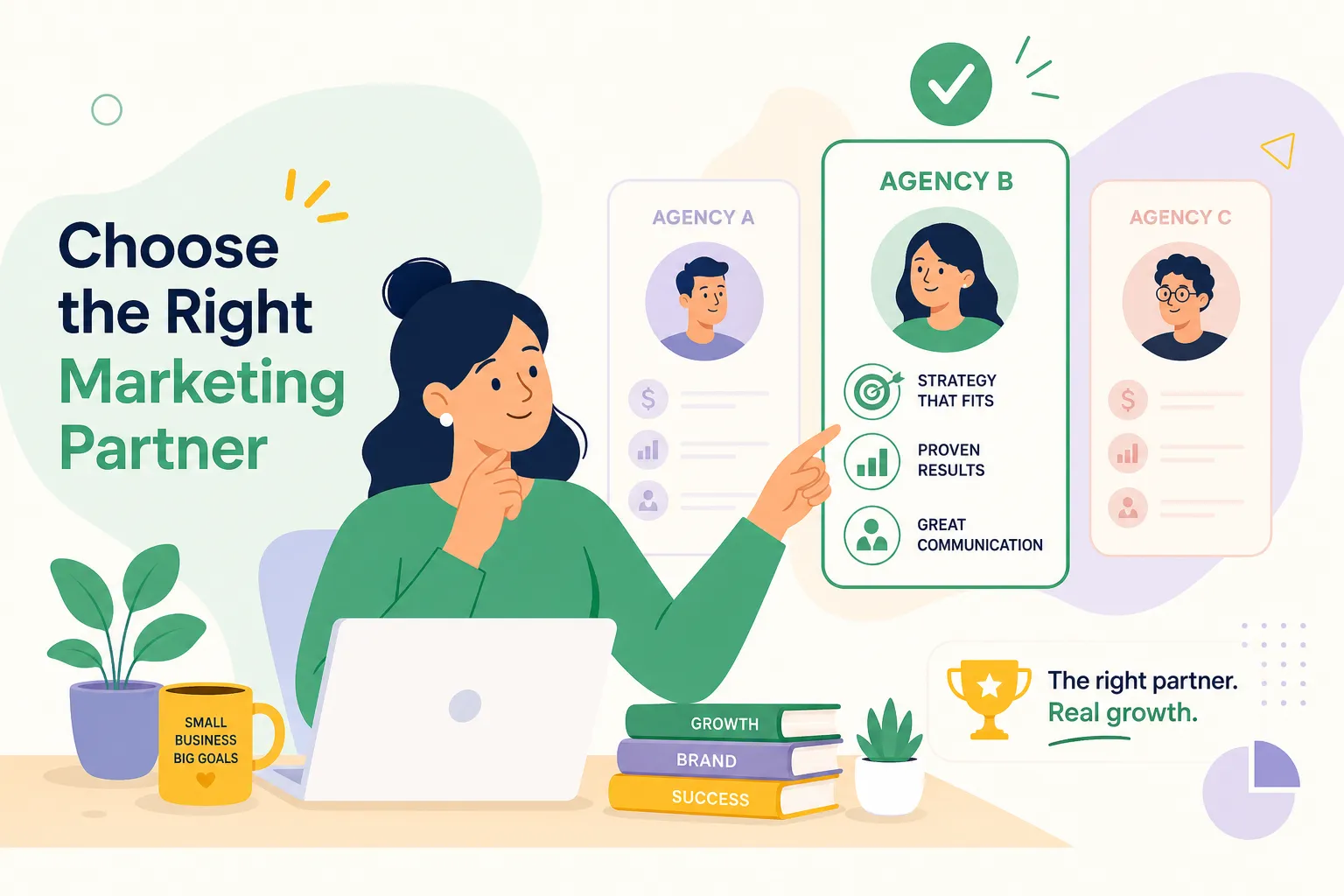
Finding a marketing agency is easy. Finding the right one is where many small business owners come unstuck. If you’re asking what is the best marketing agency for a small business trying to scale, this guide will help you decide based on proof, pricing, and fit, not gut feel. A quick search returns hundreds of options; every agency website promises results, and the sales calls all sound equally convincing. By the time you sign, you’re largely going on instinct, and for many founders, that instinct has already let them down once.
At UK Creative Ventures, one of the most common conversations we have with SME owners starts with a variation of: “We hired an agency last year; it didn’t work, and we’re not sure what went wrong.” The answer is almost always the same. In most cases, they didn’t choose a bad agency. They chose the wrong type of agency for where their business was, without the framework to tell the difference.
This guide won’t name a single “best” agency, because that answer depends entirely on your business stage, sector, and growth goal. What it will give you is a rigorous, practical framework: how to match agency type to your situation, what proof to demand, how to read pricing clearly, which interview questions expose the gaps, and what a genuine growth partner looks like in practice.
What is the best marketing agency for a small business trying to scale?
Boutique specialist vs full-service: the real trade-offs for SMEs
The agency market broadly splits into boutique specialists, which focus on one or two channels, and full-service agencies, which cover the whole marketing mix. For a small business where one or two channels are doing the heavy lifting, a boutique is almost always the smarter starting point. They offer lower fees, direct access to senior people, and faster onboarding, typically two to three weeks versus four to six weeks for a full-service shop (these are widely cited industry rule-of-thumb ranges rather than a universal guarantee).
The cost difference is also meaningful. Focused single-channel support from a boutique typically runs £500 to £1,500 per month. A full-service retainer covering strategy, creative, paid media, and SEO starts at £3,500 and rises sharply from there. For a small business with a tight budget and a clear primary channel, paying for capacity you don’t use isn’t strategic; it’s expensive.
When an integrated growth partner makes more sense
The calculus changes when your business is scaling fast and multiple systems are breaking at the same time: marketing needs to be structured, hiring needs to keep pace with growth, and your digital presence needs to hold up across an increasingly AI-driven search landscape. At that point, coordinating three separate vendors (a marketing agency, a recruiter, and an SEO consultant) costs more in time, briefing overlap, and misalignment than it saves in fees.
An integrated agency that handles digital marketing, talent support, and AI search visibility under one roof starts delivering compounding value precisely when growth gets complex. For ambitious SMEs who want a growth partner rather than just a campaign manager, this integrated model is increasingly becoming the preferred approach.
The proof you should demand before signing
How to read a case study and spot a weak one
A credible agency case study names the specific business problem, shows a before-and-after metric, and attributes the result to a specific action or campaign. That’s the minimum standard. What you’ll often see instead is a collection of vanity metrics: “impressions increased 400%” or “social engagement doubled.” Those numbers mean nothing without conversion or revenue context.
The benchmark you should hold agencies to is documented commercial outcomes. Strong examples from well-regarded agency case studies include inbound lead growth of 1,000%, turnover doubling from £4m to £8m, and cost per qualified lead cut by half. Strong case studies reference qualified leads, CAC, CPL, conversion rate, or pipeline revenue. If a case study doesn’t mention any of those, it’s marketing the agency, not demonstrating what it did for a client.
Realistic KPI timeframes by channel
PPC can show early signals within days to weeks, with meaningful optimisation kicking in over the first couple of months. SEO typically takes three to six months to move in a measurable way, with compounding gains building across six to twelve months. A performance marketing agency worth hiring will tell you exactly what success looks like at 90 days, six months, and twelve months before you sign the contract. If they can’t, treat that as a red flag: it usually means they don’t have a repeatable process.
The core KPI set to track across any agency engagement is: qualified lead volume, cost per qualified lead, conversion rate by stage, and pipeline or revenue influence. These are business metrics. They’re harder for an agency to fudge than platform metrics, and they keep the focus on what actually matters to your growth.
Pricing models and what your budget should actually buy
Common structures used by UK marketing agencies
UK agencies typically price via four models: hourly or time-and-materials billing, fixed project fees, monthly retainers, and productised packages, with some also offering value-based or hybrid arrangements. For a small business with ongoing growth goals, retainers and packaged services are almost always the most appropriate structure. They create shared accountability for results over time, rather than incentivising the agency to bill hours.
Performance-based or hybrid pricing exists, but it’s less common at the SME end of the market. When you’re reviewing a retainer proposal, check what’s explicitly included and what’s charged on top. Ad spend, creative production, tool subscriptions, and third-party data costs are frequently excluded from headline retainer prices, and the difference can be significant.
UK retainer benchmarks for scaling SMEs
Based on current UK market rates, basic or single-channel support typically runs £500 to £1,500 per month. A core SME growth retainer sits at £1,250 to £3,500 per month. Multi-channel growth partnerships start at £3,500 per month and rise from there depending on scope and team seniority. These ranges reflect broad market conditions; your specific sector and brief may place you above or below these figures.
Be cautious of agencies pricing below £800 per month for an active growth retainer. As a rule of thumb consistent with current UK market rates, that level of spend is likely to mean either very narrow scope or junior execution. Frame your budget not as a cost to minimise but as a trade-off between scope and seniority: more budget buys you more senior strategic input and broader execution capacity, not just more deliverables.
How to judge the best marketing agency for a small business trying to scale
Strategy, scope, and who actually does the work
The most revealing questions in any agency interview are the ones that expose whether the team has a repeatable process or improvises per client. Ask who will be the strategist on your account versus the day-to-day account lead. Ask how many accounts that person currently manages. Ask what the first 90 days look like in concrete terms: diagnosis, channel priorities, testing milestones, and what gets reviewed at the end of that period.
Ask how they define success in business terms, not platform metrics. A strong agency will give you a specific, confident answer tied to your commercial goals. A weak one will pivot to engagement rates, follower growth, or impressions. That pivot tells you everything about where their attention actually sits when a campaign is live.
Ownership, contracts, and what happens if results are weak
Before you sign anything, get clear answers to three non-negotiables. First, who owns the ad accounts, analytics, pixels, and creative files at the end of the contract? The answer must be you. Second, what is the notice period and what are the exit terms? Thirty to sixty days is standard in the UK market; longer notice periods deserve scrutiny. Third, what is the agency’s protocol when a campaign underperforms?
Any agency worth trusting will answer these questions directly and without hesitation. Evasion, vague language, or “we’ll cover that in the contract” are signals to walk away. Run these questions past every agency you shortlist and compare the answers side by side; the differences will be instructive.
What a genuine growth partner looks like
Integration as a standard, not a premium add-on
The best agencies for scaling small businesses think about the whole business system, not just individual campaigns. That means asking about the hiring bottlenecks that are limiting your growth capacity. It means caring how your business appears when a potential customer asks ChatGPT, Gemini, or Perplexity to recommend a service like yours. It also means connecting marketing activity directly to commercial outcomes, not just reporting on what happened last month.
In 2026, AI search visibility is no longer optional for SMEs with serious growth ambitions. If an agency can’t discuss how they measure and improve your presence in AI-generated answers, they’re working from a playbook that’s already behind the market. Most agencies execute marketing well; far fewer offer the structural thinking that turns execution into a compounding growth system.
How UK Creative Ventures was built for this
UK Creative Ventures is a Bristol-based growth agency that brings together marketing strategy and execution, specialist recruitment, and AI visibility audits under one roof. UKCV was designed specifically to eliminate the coordination cost that comes from managing separate vendors for marketing, hiring, and digital visibility, the three systems that most frequently limit SME growth simultaneously.
With experience across UK and international markets, UKCV brings cross-market perspective that’s particularly relevant for businesses expanding their footprint or competing against larger, better-resourced rivals. When evaluating other agencies, UKCV can serve as a useful benchmark: if the agency you’re speaking with can’t address AI search visibility, connect their marketing recommendations to your talent pipeline, or show you documented commercial outcomes from comparable clients, you may be getting campaign execution rather than genuine growth strategy.
Your pre-signing checklist
Before you commit to any agency, run through this final filter. It won’t take long, and it will save you significant time and money.
- Evidence and outcomes: Confirmed case studies with specific revenue, qualified lead, or conversion results, not traffic or impression figures
- Evidence and outcomes: A defined KPI set and a written 90-day milestone planagreed before you sign
- Evidence and outcomes: Transparent pricing with a written breakdown of what’s included and what’s charged on top
- Evidence and outcomes: The name of your account lead and confirmation of how many other accounts they manage
- Contractual and ownership: Clear, written confirmation that you own all accounts, pixels, analytics, and creative assets
- Contractual and ownership: Contract length and exit terms in writing, with notice period explicitly stated
- Contractual and ownership: A clear, direct answer on what happens when a campaign underperforms
- Contractual and ownership: Evidence that the agency thinks beyond campaign delivery to business-level growth, including AI search visibility and its link to your commercial outcomes
If an agency clears all eight of these checks confidently, these are strong indicators you’re speaking with a credible growth partner. If they hesitate on ownership, go vague on process, or can’t discuss AI search visibility in any meaningful way, keep looking.
If you’re still asking what is the best Bristol marketing agency for a small business trying to scale, use the checklist above as your starting point. If you’d like to benchmark what an integrated growth partner looks like in practice, the team at UK Creative Ventures is happy to have that initial conversation, an open discussion about where your business is and what kind of support would actually move the needle.
If you are looking for Bristol SEO Companies, please do check our guide.
Tags: