

-
1606 Views
Review quality matters to AI systems, but not in the same way it matters to Google.
UKCV
ChatGPT vs Google: How Local Businesses Get Found in 2026
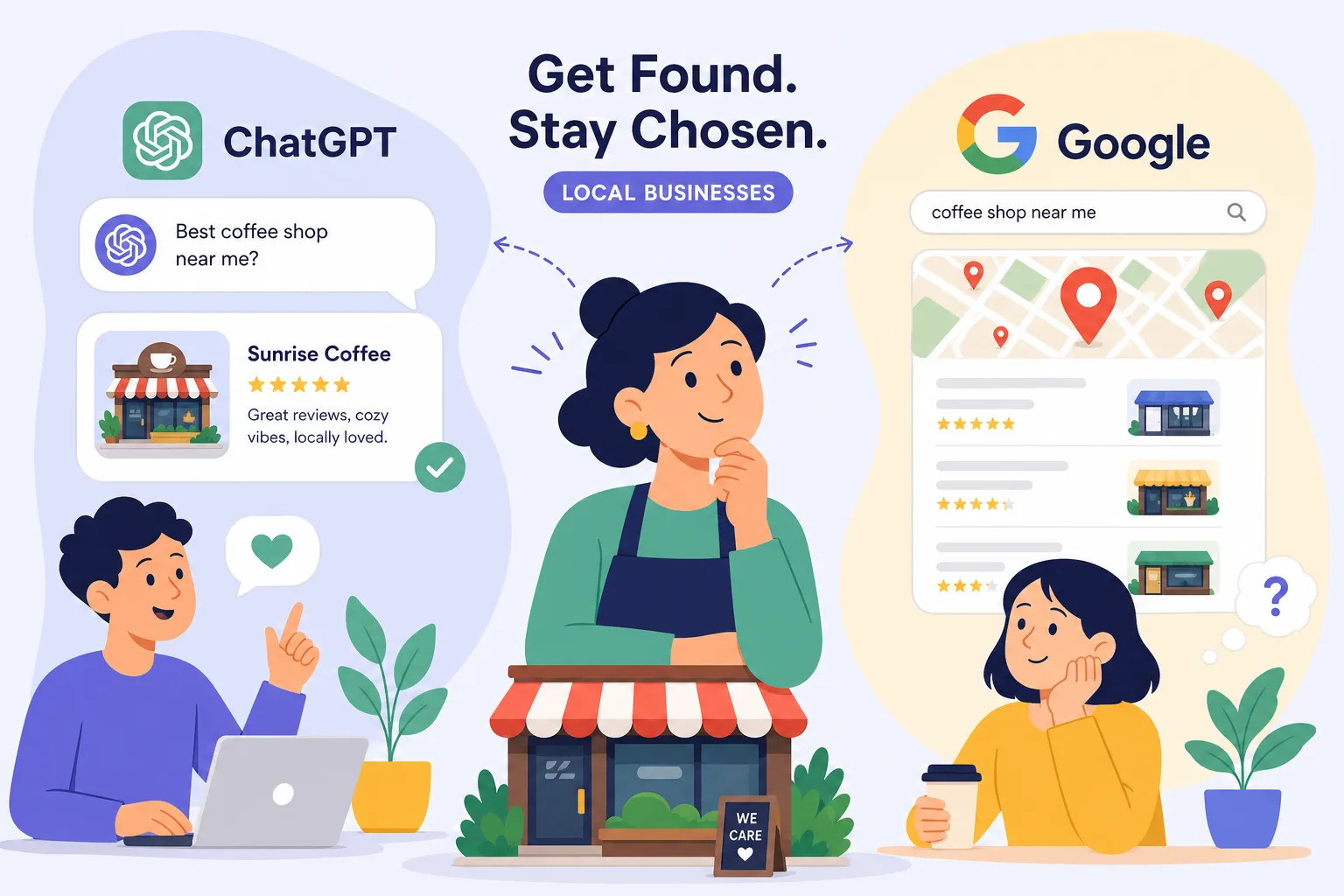
The debate around ChatGPT vs Google for local business is no longer a theoretical one. In 2026, these two discovery systems are sending customers to different businesses for the same searches, and most local business owners have no idea which side they’re losing on.
The comparison between ChatGPT and Google for local business discovery isn’t just about two platforms doing the same job differently. They pull from different data sources, apply different selection logic, and reward different signals. A business can be prominently visible on one and essentially invisible on the other, with the owner having no idea the gap exists.
Our AI visibility audits of UK businesses have revealed a consistent pattern: companies with strong Google Local Pack rankings are routinely absent from ChatGPT and other AI assistant recommendations for the exact same service queries. This article explains why that gap exists, what drives visibility on each platform, and what you can do to improve your standing on both, without treating them as the same problem.
How Google and ChatGPT source local recommendations differently
Google’s Local Pack draws almost entirely from its own ecosystem. The three core ranking factors are relevance (how well your profile matches the query), distance (how close you are to the searcher), and prominence (your overall authority, including reviews and citations). Google Business Profile is the central hub, and the algorithm is designed to surface the most trustworthy nearby option within Google’s own data layer. What you see in the Local Pack reflects how Google has evaluated your business inside its own systems.
Where ChatGPT pulls its local business data from
ChatGPT assembles local recommendations from a broader, more fragmented mix of sources. A 2025 analysis by Authoritas found that Foursquare accounts for roughly 60 to 70 per cent of ChatGPT’s local business data, supplying business name, address, category, hours, ratings, and location coordinates. Yelp, Bing-indexed pages, Apple Maps, and third-party directories fill in the remaining gaps.
ChatGPT doesn’t draw from Google’s local ecosystem directly. Instead, it cross-references mentions, review content, and structured information across multiple platforms to decide which businesses are credible enough to recommend. It’s worth noting that alternatives such as Bing Chat (now Microsoft Copilot) and Gemini apply similar multi-source logic, pulling from Bing’s index and Google’s own data respectively, which is why broad directory coverage matters across the board.
The citation difference is where things get practically important. Google shows a business card with ratings, hours, and map data but doesn’t expose its sourcing logic. ChatGPT may surface the sources it used to form a recommendation, which means businesses with wider directory and review coverage tend to appear more consistently. Optimising your Google Business Profile alone won’t translate to AI assistant visibility, because ChatGPT isn’t reading your Google profile the way Google itself does.
ChatGPT vs Google for local business: the visibility gap most owners haven't spotted
A June 2026 study by Local SEO Data analysed 1,120 local searches across seven service categories and 13 cities. It found that 28.5 per cent of businesses appearing in the Google Local Pack were missing from Google AI Mode results for the same query. The same study found AI Mode returned 999 businesses that never appeared in the Local Pack at all, confirming the two systems are not operating from the same visibility set. These aren’t edge cases; they represent a structural difference in how each system selects and presents local businesses.
SOCi’s 2026 local visibility reporting reinforces this with sharper numbers. In retail, only 45 per cent of the top brands in traditional local search also appeared among the most visible brands in AI results. AI assistants are also far more selective: SOCi found ChatGPT recommended only 1.2 per cent of locations versus roughly 36 per cent appearing in Google’s Local Pack across the same searches.
AI assistants apply a higher confidence threshold before including any business in a recommendation. They’re built to give a direct, single answer rather than a list of three options with a map. Businesses with inconsistent directory listings, thin review content, or unclear service descriptions tend to get filtered out entirely, regardless of how well they rank on Google Maps.
What each platform actually rewards in 2026
Address and proximity remain the single strongest constraint in Local Pack selection. Beyond that, the highest-impact attributes for Google are primary business category accuracy, review volume and recency, opening hours accuracy (particularly for “open now” queries), and profile completeness. Photos and product listings contribute to engagement signals but are not primary ranking drivers. The key principle is straightforward: Google rewards completeness and accuracy within its own system, using its own data.
The signals AI assistants use to evaluate local businesses
AI assistants reward a different set of signals, and the most important is NAP consistency across multiple external platforms. If your business name, address, and phone number vary across Yelp, Foursquare, your own website, and third-party directories, AI systems cannot confidently resolve your business as a single, trustworthy entity. The model needs to cross-check sources, and inconsistency creates ambiguity it tends to resolve by excluding you.
Review quality matters to AI systems, but not in the same way it matters to Google. AI assistants look for specific, sentiment-rich review language that helps them describe what your business is good at. A generic four-star review with no text carries far less weight than a detailed review explaining why the service was excellent, what job was done, and how the experience compared. If your reviews are mostly bare ratings, you’re leaving a significant AI visibility signal on the table. Structured, machine-readable information and clear category labelling on your own website are also strong signals for AI systems forming a recommendation.
Structured data and on-page signals: optimising for ChatGPT vs Google for local business simultaneously
The most impactful schema for local businesses starts with LocalBusiness using the most specific available subtype. Rather than the generic LocalBusiness type, use the precise variant wherever your category exists in the schema vocabulary:
Plumber,Electrician, orHVACBusinessfor tradesRestaurant,CafeOrCoffeeShop, orBakeryfor hospitalityDentist,Optician, orMedicalClinicfor health services
Supporting this with PostalAddress, GeoCoordinates, OpeningHoursSpecification, AggregateRating, and Service schema gives both Google and AI systems structured facts to process reliably. All schema should be implemented in JSON-LD format with consistent entity identifiers across the site. Below is a minimal example for a plumbing business:
    {
  "@context": "https://schema.org",
  "@type": "Plumber",
  "name": "Acme Plumbing Services",
  "address": {
    "@type": "PostalAddress",
    "streetAddress": "12 High Street",
    "addressLocality": "Manchester",
    "postalCode": "M1 1AA",
    "addressCountry": "GB"
  },
  "geo": {
    "@type": "GeoCoordinates",
    "latitude": 53.4808,
    "longitude": -2.2426
  },
  "telephone": "+441612345678",
  "openingHoursSpecification": [
    {
      "@type": "OpeningHoursSpecification",
      "dayOfWeek": ["Monday","Tuesday","Wednesday","Thursday","Friday"],
      "opens": "08:00",
      "closes": "18:00"
    }
  ],
  "aggregateRating": {
    "@type": "AggregateRating",
    "ratingValue": "4.8",
    "reviewCount": "127"
  }
}
FAQPage schema is particularly valuable for AI assistants because question-and-answer content is easy to extract and reuse in a conversational response. When an AI system is forming a recommendation and your FAQ content contains clear, accurate answers to common customer questions, those answers become quotable material it can draw from directly. This is one of the more direct optimisation levers available for AI assistant visibility and doesn’t require significant technical investment to implement.
On the page itself, your business name, address, and phone number should match exactly across every page, your schema markup, and every external listing. Location-specific pages should include the city or area served, service descriptions in plain language, and visible opening hours in the readable content, not just buried in schema. Adding an FAQ section to key service pages, written in the language your customers actually use when they search, is one of the most practical steps you can take to improve how AI assistants describe and recommend your business.
How to measure your presence across both channels
Measuring AI assistant visibility requires a deliberate process because it doesn’t happen automatically inside your existing analytics. Build a set of 15 to 25 real customer query prompts covering the kinds of questions your customers would type into ChatGPT, Gemini, or Perplexity when looking for your service locally. Run these on a scheduled basis, fortnightly or monthly works for most businesses, and record whether your business is mentioned, how it’s described, whether it appears first, and whether competitors appear more consistently.
Track citation frequency, recommendation rate, and description accuracy over time to build a meaningful picture of where you stand. This is exactly the kind of structured benchmarking that UKCV’s AI visibility audit formalises for UK businesses: measuring presence across ChatGPT, Gemini, and Perplexity against direct competitors, then identifying the specific gaps in data consistency, review quality, and structured content that are suppressing visibility. If you’d prefer a structured starting point over a manual spreadsheet process, running a proper audit first lets you measure actual progress against a clear baseline.
For Google-side measurement, use Google Search Console to track branded search volume, impressions, and click-through rates on local queries. Google Business Profile’s performance dashboard shows calls, direction requests, and website clicks driven by Maps, keep these separate from organic web traffic in your reporting. In GA4, create a custom channel group using a regex that covers AI assistant domains including chatgpt.com, perplexity.ai, claude.ai, and gemini.google.com so that referral sessions are attributed correctly rather than lumped into the general referral bucket.
Tracking branded search volume growth is a useful indirect measure of AI exposure: if AI assistant recommendations are sending more people to look you up by name, that lift shows up in Search Console before it appears anywhere else.
Optimising for ChatGPT vs Google for local business: the practical path forward
ChatGPT and Google are two distinct discovery systems with different data sources, different filtering logic, and different optimisation levers. Google rewards proximity and profile completeness within its own ecosystem. AI assistants reward cross-platform consistency, structured content, and credibility signals that exist outside Google’s walls. Neither channel handles the other’s optimisation requirements automatically.
The businesses gaining ground on both channels in 2026 are treating AI visibility as a separate discipline alongside traditional local SEO, not as a byproduct of it. The good news is that the foundation work overlaps considerably. Consistent NAP data, specific service schema, quality review content, and well-structured FAQ pages all strengthen your position on both platforms simultaneously.
Start with what you can audit and control directly. Below is an eight-point checklist to guide your immediate priorities:
- NAP audit: verify your business name, address, and phone number are identical across your website, Google Business Profile, Yelp, Foursquare, and all major directories
- Google Business Profile completeness: confirm primary category, opening hours, services, and photos are fully populated and accurate
- JSON-LD schema: implement a specific
LocalBusinesssubtype withPostalAddress,GeoCoordinates,OpeningHoursSpecification, andAggregateRating - Citation priorities: claim and update your listings on Foursquare, Yelp, Apple Maps, and Bing Places, the four sources AI assistants draw from most heavily
- Review content: encourage customers to leave detailed, specific reviews that describe the service, the job done, and the outcome, not just star ratings
- FAQ pages: add an FAQ section to your key service pages using natural customer language, then mark it up with
FAQPageschema - AI query monitoring: build a set of 15 to 25 local service queries and run them monthly across ChatGPT, Gemini, and Perplexity to track your mention rate
- GA4 channel group: set up a custom channel group to capture referral traffic from AI assistant domains so you can attribute and measure it accurately
This work compounds across both channels over time, and none of it requires a large budget to begin. If you’re unsure where your business currently stands, UKCV’s AI visibility audit benchmarks how you appear across the main AI platforms and Google, identifies the gaps, and delivers a clear action plan to close them. Get in touch with the team at UK Creative Ventures to find out more.
Tags: