

-
2374 Views
Visibility inside AI-generated answers is no longer a nice-to-have for businesses that depend on search traffic.
UKCV
About 48, 50% of Google searches now trigger an AI Overview, according to large-scale 2026 tracking studies (figures predominantly reflect US samples and methodologies vary). On informational queries, organic click-through rates have dropped by anywhere from 25, 38% in the more conservative analyses, with some studies reporting declines of up to 61% for certain query types when an AI Overview appears. That is not a forecast; it is the current baseline. Understanding the difference between generative AI vs traditional SEO has never mattered more, because traditional SEO has not died, but the logic underneath it has quietly shifted in ways that most businesses have not yet caught up with.
The real problem is not that AI search is new. It is that two separate systems now decide whether your business gets found online, and they use fundamentally different criteria to make that decision. Businesses that treat generative AI search and traditional SEO as the same thing keep losing ground without understanding why their traffic is sliding.
At UK Creative Ventures (UKCV), working with SMEs on digital visibility and AI search audits out of our Bristol base, we observe this pattern regularly. A business ranks on page one, organic impressions are up, yet sessions are falling. In many cases, AI Overviews appear to be surfacing the content and intercepting the click, and the business has no idea it is happening. (This pattern is worth investigating rather than assumed to be universal; seasonality, SERP feature changes, and tracking discrepancies can all contribute.) By the end of this article, you will understand both systems, know which signals to prioritise, and have a clear six-step plan to act on.
Why generative AI and traditional search use completely different logic
Traditional search has always followed a crawl, index, rank, display model. Search engines score pages based on authority signals: backlinks, domain trust, keyword relevance, and click behaviour. The result is a ranked list of links. The user chooses where to go. Discovery is driven by the person searching.
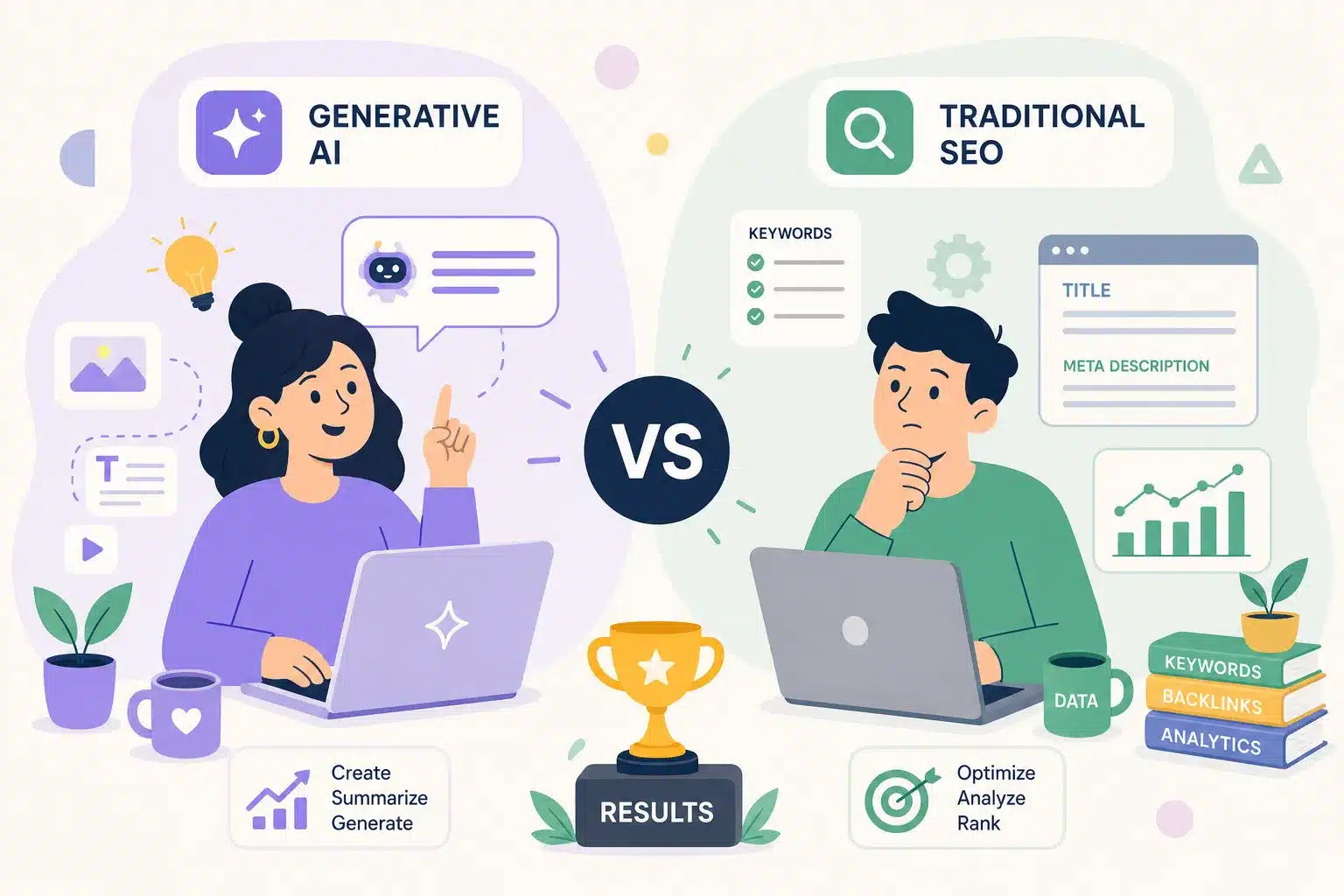
Generative AI systems work differently. Tools like ChatGPT (with search enabled), Perplexity, and Google AI Overviews follow a retrieve, rank, extract, synthesise, cite pipeline. They do not return a list. They generate a single synthesised answer and attach citations to the specific passages they used. Getting cited in that answer is the new form of ranking, and it requires a different kind of content to earn it. This is what makes the generative AI vs traditional SEO question so consequential for businesses in 2026.
The commercial stakes of AI-driven search
The commercial impact is direct. Estimates suggest roughly 58, 65% of Google searches now end without any click to an external site (figures vary by methodology and market). For informational queries, CTR can be substantially lower when an AI Overview appears. A Pew-style behavioural study found users clicked a traditional result in only 8% of visits when an AI summary was present, compared with 15% when it was not, though the precise source and sample should be noted as subject to variation across studies. Visibility inside AI-generated answers is no longer a nice-to-have for businesses that depend on search traffic.
The signals each ecosystem actually rewards
Traditional SEO still responds to the signals you know: backlinks and domain authority, keyword placement and topical relevance, page speed and Core Web Vitals, and engagement metrics like click-through rate and dwell time. These signals remain important, particularly for transactional and navigational queries where the user intends to visit a site rather than read a summary.
What generative AI systems look for
Generative AI systems look for something different. The signal set that matters for Generative Engine Optimisation (GEO) and Answer Engine Optimisation (AEO) includes factual consistency, clear entity alignment, extractable standalone statements, corroboration across multiple sources, fresh and accurately dated content, and genuine E-E-A-T signals that go well beyond a checkbox author bio. AI systems are looking for content they can trust and quote, not just content they can rank.
The most important insight is where the two sets of signals overlap. Both ecosystems reward high-quality, well-structured, authoritative content. Strong E-E-A-T, clear topical coverage, and a clean site architecture benefit both traditional rankings and generative citation. Businesses do not need two entirely separate strategies. They need one strategy built well enough to satisfy both systems simultaneously.
Platform differences: Google AI Overviews, ChatGPT, and Perplexity
Google AI Overviews start from the same underlying index as traditional search, then apply an additional selection layer to identify which already-ranking pages contain extractable, citable passages. Pages with strong traditional SEO have a head start, but they still need answer-first formatting and explicit factual statements to make it into the generated summary. A high-ranking page that buries its answer in long narrative text can be skipped entirely, a key distinction in any generative AI vs traditional SEO comparison.
Chat-style systems like ChatGPT (with search enabled) and Perplexity use retrieval-augmented generation (RAG): they rewrite the query, retrieve relevant passages from across the web, re-rank them by trust and relevance, and synthesise an answer with citations. Critically, these systems often index sources that rank lower in traditional Google results. A business with modest SEO can still be cited if its content is well-structured, specific, and clearly attributed. Brand presence beyond your website, on LinkedIn, Reddit, and industry publications, correlates with higher citation likelihood across indexed platforms, based on available citation audits and GEO research.
Content and structural tactics that make your pages citable
The single most impactful change you can make is to lead each section with a direct, standalone answer. AI systems extract content at the passage level, not the page level. A well-structured page that buries its key points inside long narrative text will not be cited even if it ranks well. Keep paragraphs short, write sentences that can be quoted without the surrounding context, and put the answer before the explanation.
Schema markup does meaningful work here too. FAQPage schema for question-and-answer blocks, HowTo schema for step-based content, Article schema for editorial content with named authorship, and Organisation and Person schema for brand and author identity all strengthen the trust signals AI systems use to verify and attribute content. You can confirm your structured data is being read correctly using Google’s Rich Results Test. Visible authorship with credentials, clear publication dates, and consistent brand descriptors across the web are all signals the systems are actively checking.
Content formats that work across both ecosystems include question-based H2 and H3 headings that mirror real user prompts, comparison tables for multi-entity queries, and FAQ sections covering commonly raised questions on a topic. These formats help both traditional SERP features (featured snippets, People Also Ask) and AI citation selection simultaneously, which means the structural investment pays twice.
A 6-step roadmap for generative AI vs traditional SEO visibility
Here is the practical action plan, in the order it makes sense to work through it.
Step 1: Audit your current visibility across both search types. Check your traditional rankings in Google Search Console and separately test how your business appears when queried directly in ChatGPT, Perplexity, and Google AI Overviews. Many businesses have no idea what these platforms currently say about them, or whether they appear at all.
Step 2: Restructure your top pages for extractability. Add a direct answer block at the top of key pages, shorten paragraphs to one clear idea each, and add FAQ sections where relevant. Prioritise the pages driving the most impressions in Search Console.
Step 3: Add and clean up schema markup. Prioritise FAQPage, Article, HowTo, and Organisation schema on relevant pages. Verify your structured data with Google’s Rich Results Test to confirm it is being read correctly.
Step 4: Strengthen entity and authorship signals. Ensure every content piece has a named author with a bio and verifiable credentials. Align your brand descriptors consistently across your website, LinkedIn profile, and any third-party mentions. Inconsistency across sources weakens entity recognition.
Step 5: Build topical depth, not just individual pages. Cluster related content around core topics so your site signals comprehensive authority rather than isolated articles. A content hub covering a subject thoroughly is far more likely to be cited than a single well-written post.
Step 6: Distribute beyond your website. Publish on platforms AI engines regularly index: LinkedIn, relevant Reddit communities, industry publications, and newsletters. Corroboration and third-party mentions across indexed platforms are associated with higher citation likelihood across all the major generative platforms.
Measuring what's actually working in an AI-first search environment
Traditional metrics remain essential. Rankings, organic impressions, click-through rate, and conversion data from Google Search Console all still tell you important things. The key pattern to watch for is divergence: rising impressions with falling CTR often signals that AI Overviews are surfacing your content but intercepting the click. That means your content is being used by the system, but you are not getting the traffic benefit from it.
Standard dashboards will not show you what is happening inside generative answers. To track that, manually test key queries across ChatGPT, Perplexity, and Google AI Overviews on a regular basis and note whether your business is cited, how it is described, and whether any of that information is inaccurate. Shifts in direct traffic, branded search volume, and third-party mentions can also indicate AI visibility gains, since users who encounter your brand in an AI answer often search for it directly afterwards.
If you want a structured baseline before reworking your content strategy, an AI visibility audit can help identify likely citation gaps, misattribution, or absence across the major generative platforms, and is often a useful starting point, though methodologies and coverage vary. It points your attention to where the gaps actually are, rather than where you assume they might be.
The practical conclusion: choosing your approach in 2026
When weighing generative AI vs traditional SEO, the answer is not an either/or decision. They are two layers of the same visibility challenge. Businesses that treat them as separate problems end up optimising for the wrong system at the wrong time, often without realising it until the traffic data makes it unavoidable.
The core shift is this: traditional SEO optimises for discoverability and clicks; GEO and AEO optimise for extractability and citation. The overlap between those two objectives is larger than most people assume. One well-built content strategy, structured clearly, attributed properly, and distributed beyond your own site, can serve both systems at once.
Start with the audit step from the roadmap above. Understand where you currently stand across both ecosystems before making changes to your content or technical setup. If you want expert support with that mapping, UK Creative Ventures’ AI visibility audit is designed to give you a clearer picture of how your business appears across ChatGPT, Perplexity, and Google AI Overviews, and where to focus first. Find out more about our AI visibility audit here.
Tags: