

-
2329 Views
Consistency in your testing approach matters more than having the perfect tool.
UKCV
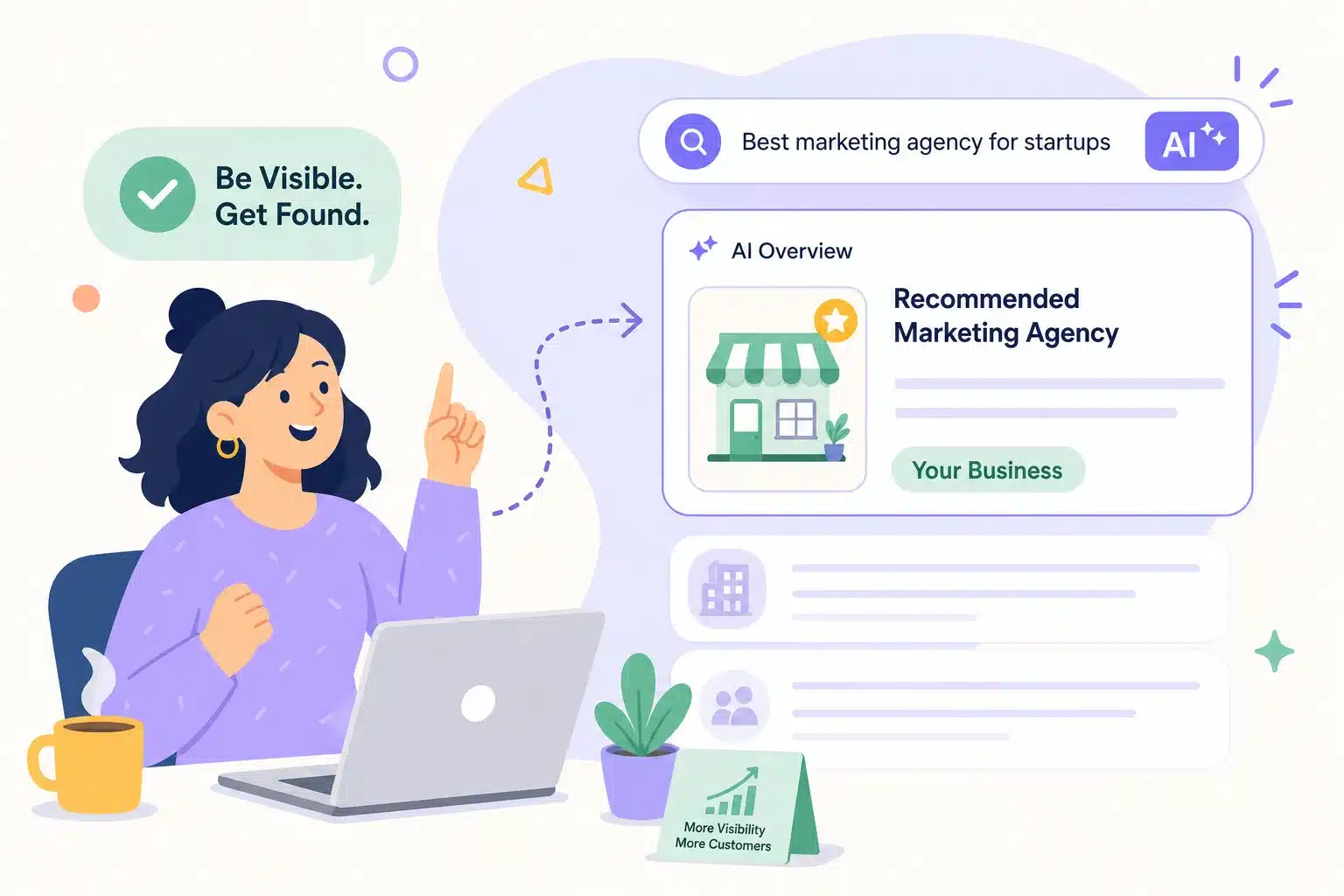
How do I make my business appear in AI searches? It’s a question more UK business owners are asking as they notice something unsettling: their website ranks on page one of Google, yet when someone asks ChatGPT or Perplexity for a recommendation in their category, their business isn’t mentioned at all. Many businesses that perform well in traditional search simply aren’t being cited by AI assistants, and the gap between the two isn’t narrowing on its own.
AI search tools are reshaping how people discover and evaluate businesses before they ever visit a website. The problem is that the optimisation playbook most businesses follow was built for a traditional search index, not for systems that synthesise answers from multiple sources and decide, in seconds, whether your business is worth citing. What earns you a Google ranking and what earns you a mention in a generative AI answer are related, but they are not the same thing.
This article covers the technical foundations, content structure, authority signals, and measurement approach that determine whether AI systems cite your business or pass you over entirely. The team at UK Creative Ventures (UKCV) runs structured AI visibility audits for UK SMEs, having observed consistently that the gap between “indexed on Google” and “cited by AI” catches most business owners off guard, and that it becomes entirely fixable once you know what to address.
Why AI searches behave differently from Google
How platforms like ChatGPT and Perplexity decide what to surface
Generative AI tools do not run a real-time index scan the way Google does. They synthesise answers from training data, live web retrieval, and curated data sources, then construct a response that feels authoritative even when the underlying sourcing is uneven. The practical implication is significant: a business page that ranks on page one of Google may still be invisible to ChatGPT if it lacks the signals AI systems use to extract and verify factual information. Research from BrightLocal found that business websites accounted for 58% of local search sources in ChatGPT, which means your own first-party content is the highest-priority asset you control.
The difference between being indexed and being cited
Google’s AI Overviews draw from the same index as organic search but apply additional quality and relevance filters on top. Being indexed is the minimum requirement to appear as a supporting link, not a guaranteed outcome. Google has confirmed that a page must be eligible to show a snippet in standard search before it qualifies for inclusion in AI Overviews. Beyond that threshold, the systems determining whether a page is actually surfaced are the same quality and relevance systems that govern organic search. In practice, helpful, answer-structured content gets selected over promotional copy, and pages that treat the reader as someone with a real question to resolve consistently outperform pages built around keyword density.
How do I make my business appear in AI searches? Fix your foundations first
Why consistent NAP signals matter to AI systems
AI tools cross-reference business information across multiple sources simultaneously: your website, directories, review platforms, and listings. When the name, address, and phone number differ across those sources, AI systems lose confidence in the data and are less likely to surface it. A common example is an abbreviated street name on one directory and a full street name on another. To an AI system trying to confirm your business exists and is operating, that discrepancy looks like two different entities, or simply unreliable data. Standardising your NAP across every platform is the least exciting work in this process, and one of the most consequential.
The LocalBusiness schema properties that do the most work
Implementing LocalBusiness schema as JSON-LD on your main location page gives AI systems a machine-readable summary of who you are and where you operate. The properties that carry the most weight are: name, address as a PostalAddress object, telephone, url, logo, openingHoursSpecification, and geo with latitude and longitude coordinates. One detail that makes a meaningful difference is choosing the most specific schema subtype available. If you are an accountancy firm, use AccountingService rather than the generic LocalBusiness. If you run a legal practice, use LegalService. The more specific the type, the more clearly AI systems can categorise and cite your business in relevant queries.
Using sameAs to anchor your business identity
The sameAs property is frequently overlooked in local structured data, even by businesses that have otherwise solid schema in place. It accepts an array of URLs pointing to your authoritative profiles across the web: your Google Business Profile, LinkedIn company page, Bing Places listing, Yell profile, and Companies House entry. When AI systems encounter your business across multiple queries, these links confirm they are looking at one consistent entity rather than inferring a connection. Adding four or five well-maintained sameAs references is typically an afternoon’s work and builds the kind of entity confidence that makes AI tools more likely to describe your business accurately and consistently.
How do I make my business appear in AI searches? Format content AI can actually quote
The 40, 80 word answer formula for FAQ pages
FAQ-style content with concise, direct answers is the format most reliably extracted by AI answer systems. The formula is straightforward: open with a one-sentence direct answer, follow with two or three supporting sentences, include one concrete detail such as your service area, a relevant credential, or a price range, and keep the whole block self-contained and non-promotional. Compare a vague paragraph like “We offer a range of marketing services to help businesses grow” with a structured FAQ answer that begins “UK Creative Ventures provides digital marketing services to SMEs across the UK, specialising in paid advertising, content strategy, and AI visibility audits.” The second version gives an AI system something citable. The first gives it nothing to work with.
Answer-first structure on service and location pages
Service pages written as marketing copy are rarely cited by AI. Pages that open with a clear statement of what the business does, who it serves, and where it operates are far more likely to earn a citation. A reliable structure is: a short direct overview paragraph, a bulleted breakdown of specific services where enumeration genuinely helps the reader, a FAQ section addressing the questions your clients actually ask, and clear contact details. The opening paragraph of every service page should be written as if someone just asked you a direct question. In AI search terms, they did.
TL;DR summaries and how to place them
Adding a concise summary block of 100 to 150 words at the top of your key pages gives AI systems a ready-made extract. Write it as if answering “what is this page about?” in plain English: state what you do, who you serve, where you operate, and what distinguishes your approach. Analysis of Google AI Overview responses suggests these systems typically synthesise roughly 150 words from cited sources, a pattern observed across multiple studies into how AI Overviews construct their answers. A well-written summary block at that length is structurally aligned with how the system extracts content. Place it prominently near the top of the page, before promotional messaging.
Build the authority signals AI tools look for
Brand mentions, citations, and directory listings
AI tools use corroborating sources to verify business information. A business mentioned in a Trustpilot review, a local press article, and several industry directories carries more credibility to an AI system than a business that exists only on its own website. For UK businesses, the priority directories are Google Business Profile, Bing Places, Yell, and Trustpilot. For trade and service businesses, Checkatrade is worth adding. Consistent mentions across these platforms, even unlinked ones, strengthen what practitioners call entity authority: the AI system’s confidence that your business is real, established, and relevant to the query. BrightLocal’s research shows directories and review platforms are among the most frequently cited sources in ChatGPT’s local business answers. This is where AEO (Answer Engine Optimisation) and traditional local SEO overlap most directly.
E-E-A-T signals and topical authority
Experience, Expertise, Authoritativeness, and Trustworthiness are the quality signals Google uses to evaluate content, and they translate directly into AI citability. In practical terms: visible author profiles on blog posts, credentials and qualifications stated on service pages, links out to authoritative external sources, and a content library that covers your area of specialism in depth rather than breadth. Several documented case studies show that businesses restructuring content around user questions, rather than keyword density, have seen meaningful increases in AI Overview citations. A case study published by Citedify tracked a B2B firm that rebuilt its content around use-case guides and FAQ sections; it reported a 540% increase in AI Overview mentions alongside a 67% rise in organic traffic. That is a single case study, not a universal guarantee, but it illustrates the direction of travel for businesses that take E-E-A-T signals seriously.
Find your gaps before you start fixing
What an AI visibility audit actually checks
An AI visibility audit is a structured diagnostic, not a general “check your online presence” exercise. It examines whether your business appears when queried across ChatGPT, Perplexity, and Google AI Overviews; whether the information surfaced is accurate and consistent with what you want people to know; where your schema is missing or malformed; and where your content lacks the structure needed to be cited. The audit produces a prioritised fix list rather than treating every gap as equally urgent. Without this baseline, most businesses end up making changes in the wrong order and measuring nothing.
Where specialist audits like UKCV's process begin
UK Creative Ventures runs structured AI visibility audits designed specifically for UK SMEs. The process identifies the exact points where a business is invisible to generative AI tools and produces a prioritised action plan rather than a generic report. If you are not certain whether your business is being cited, recommended, or ignored entirely when potential clients ask AI tools for help in your category, an audit is a fast way to establish where you actually stand. You can learn more about the UKCV AI visibility audit service and what it covers.
How to measure whether your AI search visibility is improving
Testing your AI presence manually
Run baseline tests across ChatGPT, Perplexity, and Google AI Overviews using the queries a potential customer would genuinely type: “best [service] in [city]”, “who offers [service] near [location]”, “is [business name] reliable?” Use a private or incognito browser window so search history and personalisation do not skew results. Document what appears on each platform, whether your business is cited, and what information is shown. Treat this as a repeatable monthly exercise. Tracking competitors in the same tests is also worthwhile, AI answers often surface several businesses in a single response, and knowing who is appearing instead of you is useful intelligence.
Metrics to track as you implement changes
The signals worth monitoring are: how frequently your business appears across your tested queries, whether the information surfaced is accurate, and whether Google Search Console shows clicks attributed to AI Overviews. Perplexity and similar AI-driven platforms can appear as referral sources in analytics, which gives a secondary confirmation of citation activity, though referrer filtering and bot traffic mean this data should be treated as indicative rather than definitive. Dedicated AI search visibility tracking tools such as Otterly AI, Peec AI, and the Semrush AI Visibility Toolkit are available for businesses that want to systematise this monitoring. Consistency in your testing approach matters more than having the perfect tool. A simple spreadsheet logging query, platform, citation status, and date gives you a clear picture of progress over time.
The businesses being cited today started this work earlier
If you are asking “how do I make my business appear in AI searches?”, the answer is not one change, it is a set of interconnected foundations. Fixing schema, standardising NAP data across every directory and listing, restructuring content to answer questions directly, and building the authority signals that AI tools use to verify and cite businesses: none of these are complicated, but they do require a clear picture of your current gaps before you begin. Early adopters who implemented these changes have built a meaningful head start in AI search visibility, and that advantage compounds as AI search use continues to grow. The gap is entirely closable for any business willing to do the foundational work, but the earlier you start, the less ground you have to recover.
If you want to know exactly where your business stands, UK Creative Ventures offers AI visibility audits for UK SMEs that identify the specific gaps and tell you what to prioritise. Find out more about the audit service or get in touch to discuss your situation directly.
Tags: