

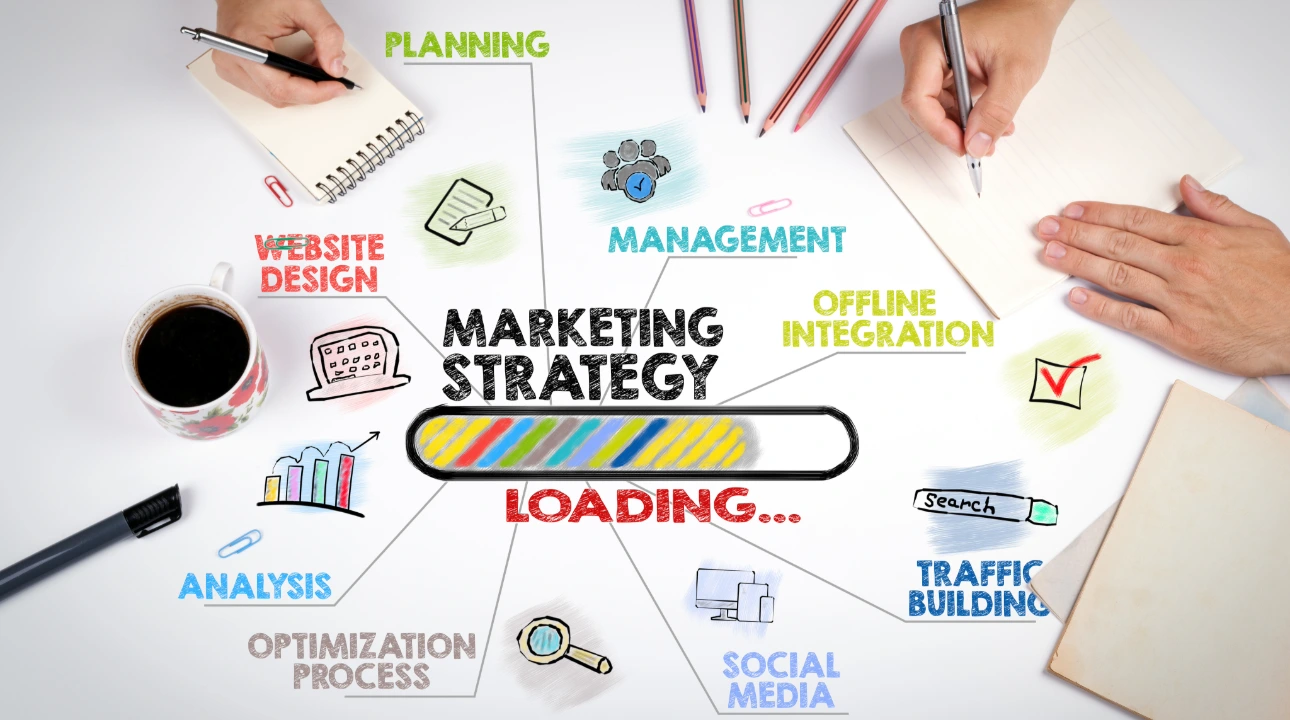
If you can't use your strategy to decide whether to invest in a new channel or kill an underperforming campaign it's not a strategy it's decoration.
UKCV
Most marketing “strategies” aren’t strategies at all.
They’re project plans. Media schedules. Lists of campaigns. Decks filled with brand values and mission statements that no one outside the marketing team has read.
A real marketing strategy is a decision-making framework that explains why you’re doing what you’re doing, who you’re trying to reach, and how you’ll know if it’s working. It’s the difference between “we’re running LinkedIn ads because our competitors do” and “we’re investing in LinkedIn because our ICP spends 40 minutes a day there, they’re in research mode at that point in the buying journey, and our win rate increases 23% when prospects engage with our thought leadership before a sales call.“
This guide explains what an actual marketing strategy contains, how to recognise when you don’t have one, and what to do about it.
The Strategy vs Tactics Confusion
Here’s the test: if you can delete a single channel or campaign from your “strategy” and nothing else changes, it’s not a strategy it’s a tactic list.
A strategy is coherent. Each component depends on the others. If you remove one part, the whole thing weakens or falls apart.
Example of a tactic list (what most businesses call a strategy):
- SEO and content marketing
- LinkedIn ads targeting decision-makers
- Monthly email newsletter
- Quarterly webinars
- Attendance at two industry trade shows
- PR outreach to trade publications
That’s not a strategy. It’s a list of things you’re doing. There’s no explanation of why those channels, how they work together, or what you expect each one to achieve.
Example of a strategy:
“We’re targeting mid-market manufacturing companies (50-500 employees) in the Midlands who are struggling with supply chain visibility. Our research shows they don’t know solutions like ours exist they think their only option is hiring more logistics staff. Our strategy is to create awareness through SEO content that ranks for their problem (not our solution), build credibility through case studies of similar companies, and convert through a self-service ROI calculator that demonstrates cost savings. We’re ignoring brand awareness channels like LinkedIn ads because our audience isn’t actively looking for vendors they’re looking for answers to operational problems. We’ll measure success by tracking organic traffic to problem-focused content, conversion rate from calculator to demo request, and sales cycle length for inbound leads vs outbound.“
See the difference? The second version explains
- Who (mid-market manufacturing, Midlands, 50–500 employees)
- What problem (supply chain visibility, unaware of tech solutions)
- Why these tactics (audience behaviour, search intent, readiness to buy)
- How tactics connect (awareness → credibility → conversion)
- What’s deliberately excluded (brand ads, because audience isn’t solution-aware)
- How success is measured (specific metrics tied to business outcomes)
That’s a strategy.
The Five Elements Every Real Strategy Contains
If your marketing strategy document doesn’t include all five of these, it’s incomplete:
1. Target Market Definition (and Exclusions)
Who exactly are you trying to reach? Not “UK businesses” or “decision-makers.” Specific industries, company sizes, geographies, job titles, pain points, buying behaviours.
Just as importantly: who are you not targeting?
A Nottingham-based cybersecurity firm might say: “We target financial services companies with 200–2,000 employees in London and Edinburgh. We do not target enterprise (too long sales cycle, requires features we don’t have) or SMEs under 200 employees (can’t afford our pricing, too much churn).”
That’s useful. It tells the marketing team who to ignore. It tells sales who not to waste time on. It focuses budget.
Most businesses are afraid to exclude anyone because they think it limits growth. In reality, trying to serve everyone means you serve no one particularly well. Specialists win. Generalists compete on price.
2. Value Proposition and Differentiation
Why should someone choose you instead of a competitor or instead of doing nothing?
This needs to be specific and defensible. “We’re the trusted partner” is not differentiation everyone says that. “We’re the only provider that integrates natively with Xero and offers same-day onboarding for accountancy firms under 10 staff” is differentiation.
Your value proposition should answer three questions:
- What problem do you solve?
- How is your approach different from alternatives?
- Why does that difference matter to the customer?
If you can’t answer all three clearly, your messaging will be vague, your sales team will struggle to articulate value, and your win rate will suffer.
3. Channel Selection and Rationale
Which channels will you use, and why those specific channels?
The “why” matters more than the “what.” Every channel choice should be justified by:
- Where your audience spends time
- What stage of the buying journey each channel serves
- What you're uniquely capable of doing well in that channel
- What ROI you expect (and over what timeframe)
A Bristol-based recruitment agency might choose:
- LinkedIn organic content (their audience is active there daily, it's a credibility-building channel, and their founder is a strong writer)
- Google Ads for high-intent keywords (people searching "financial services recruiter Bristol" are ready to talk now)
- Email nurture for candidates (building a talent pool for future placements)
They might deliberately not choose:
- TikTok (audience isn't there)
- SEO for informational content (long payback period, limited budget)
- Trade shows (expensive, unqualified leads)
The exclusions are just as strategic as the inclusions.
4. Buyer Journey and Funnel Architecture
How does someone move from “never heard of you” to “signed customer”?
Map this out stage by stage:
- Awareness: How do they discover you exist?
- Consideration: How do they evaluate whether you're a fit?
- Decision: What pushes them to choose you vs a competitor?
- Retention: How do you keep them as a customer?
For each stage, identify:
- What content or touchpoints are needed
- Which channels deliver those touchpoints
- What the conversion trigger is (what moves them to the next stage)
Most UK businesses have a gap somewhere in this journey. Common problems:
- Lots of awareness activity (blog posts, social media) but no middle-of-funnel nurture, so prospects disappear
- Strong bottom-of-funnel conversion (demos, trials) but no top-of-funnel activity, so the pipeline is always empty
- Good acquisition but terrible retention, so CAC is high and LTV is low
A real strategy identifies where the gaps are and allocates budget to fix them. How to Build a Full-Funnel Marketing Strategy (UK Case Examples) If your funnel has structural gaps most do building out the complete architecture with proper stage transitions is one of the highest-ROI exercises you can do.
Marketing Strategy for UK Businesses in 2026. Understanding how all these components fit together as part of a complete system is crucial, this cluster blog focuses on the anatomy of strategy, while the pillar page shows you how to build the entire framework.
5. Success Metrics and Decision Criteria
What does success look like, and how will you know if you’re on track?
This means defining:
- Leading indicators (early signals that predict future success): traffic, MQLs, demo requests
- Lagging indicators (outcomes that matter commercially): pipeline, revenue, CAC, LTV
- Timeframes (when you expect to see results): SEO might take 9 months, paid ads might show results in 30 days
- Decision triggers (what would cause you to change course): if CAC exceeds £X, if conversion rate drops below Y%, if a channel doesn’t generate pipeline after Z months
Most marketing teams track dozens of metrics but can’t tell you which ones actually matter. KPI Frameworks UK CMOs Use to Measure Marketing ROI The difference between activity metrics and commercial outcomes is one of the most common reasons marketing teams struggle to prove their value to leadership.
A real strategy identifies the 5-7 metrics that correlate with business outcomes and ignores the rest.
How to Tell If You Don't Have a Real Strategy
Here are the warning signs:
Your “strategy” is a presentation, not a document. If the strategy only exists as a deck that was presented once to leadership and never referenced again, it’s not a strategy. A real strategy is a working document that the team uses to make decisions week to week.
You can’t explain why you’re doing something. If someone asks “why are we running Instagram ads?” and the answer is “because our competitor does” or “because the agency recommended it,” you don’t have a strategy.
Your tactics change every quarter. If you’re constantly chasing new channels, trends, or tactics without a stable framework underneath, you’re reacting, not executing a plan.
Sales and marketing don’t agree on what’s working. If the marketing team thinks they’re generating great leads and the sales team thinks the leads are rubbish, there’s no shared definition of success which means there’s no strategy.
You measure activity, not outcomes. If your monthly report shows how many posts you published, how many emails you sent, and how much traffic you got, but doesn’t connect any of that to pipeline or revenue, you’re tracking the wrong things.
You can’t articulate your ICP. If you’re targeting “UK SMEs” or “decision-makers” and can’t be more specific than that, your strategy is too vague to be useful.
What to Do If You Don't Have One
If you’ve realised your marketing “strategy” is actually just a list of tactics, here’s what to do:
Step 1: Stop adding new tactics. You don’t need another channel. You need clarity on why you’re doing what you’re already doing.
Step 2: Document your current state. Write down:
- Who you’re targeting (be specific)
- What channels you’re using
- What each channel is supposed to achieve
- How you measure success
- What’s working and what isn’t
Most businesses who complete this exercise discover they’re spending significant budget on channels that generate no measurable pipeline.
Why Most UK Businesses Waste 40% of Their Marketing Budget. Understanding where the leakage happens and which activities are pure waste is often the wake-up call leadership needs to take strategy seriously.
Step 3: Identify the gaps. Where is the strategy missing? Do you not know your ICP? Do you not have a clear value prop? Is your funnel broken? Are you measuring the wrong things?
Step 4: Build the missing pieces. You don’t need to rebuild everything at once. Focus on the biggest gap first. If you don’t know your ICP, start there. If your funnel has a huge hole in the middle, fix that. If you’re not measuring ROI, build a dashboard.
Step 5: Write it down. A strategy that lives in your head isn’t a strategy. It needs to be documented, shared with the team, and used to make decisions. It doesn’t need to be a 50-page document 2-3 pages is often enough if it’s clear and specific.
Step 6: Review and iterate quarterly. Strategy isn’t static. Every quarter, look at what’s working, what’s not, and what’s changed in the market. Adjust accordingly.
Why This Matters More in 2026 Than It Did Five Years Ago
The margin for error has shrunk.
Five years ago, you could run a scatter-gun approach across multiple channels, waste 40% of your budget on things that didn’t work, and still grow because the market was expanding and competition was less sophisticated.
In 2026, budgets are tighter, buyers are more skeptical, and every channel is more competitive. You can’t afford to waste money on uncoordinated tactics.
The businesses that win are the ones that know exactly who they’re targeting, why they’re targeting them, how they’ll reach them, and what success looks like. That’s not luck. That’s strategy.
Final Thought
A real marketing strategy isn’t a creative exercise. It’s not about brand purpose or big ideas. It’s a practical tool that helps you make better decisions about where to spend time and money.
If you can’t use your strategy to decide whether to invest in a new channel, kill an underperforming campaign, or prioritise one audience segment over another, it’s not a strategy it’s decoration.
Build the real thing. Document it. Use it. The businesses that do will outperform the ones that don’t, every time.
Marketing Strategy for UK Businesses in 2026 Once you understand what a real strategy looks like, the next step is building one that fits your business the pillar guide walks you through the complete process with frameworks and examples.