
-
1600 Views
Agencies measure progress through brand mention rate, citation frequency, and whether the brand is described accurately and positively when it does appear.
UKCV
The term “AI marketing agency” appears in virtually every agency pitch deck and LinkedIn profile in 2026. But ask most business owners what they actually expect from one, and the answers get vague fast. Are these agencies that use AI as a productivity tool? Agencies that have built AI into their core methodology? Or traditional shops that added “AI-powered” to their website and kept working the same way they always have?
In practice, all three exist in the market simultaneously. Most agencies claiming AI capability fall into the third category. A smaller group has genuinely integrated machine learning, automated optimisation, and data-driven decision-making into how they run campaigns. The difference matters enormously when you are spending a marketing budget and need to know whether the outcomes you are seeing are repeatable and improving.
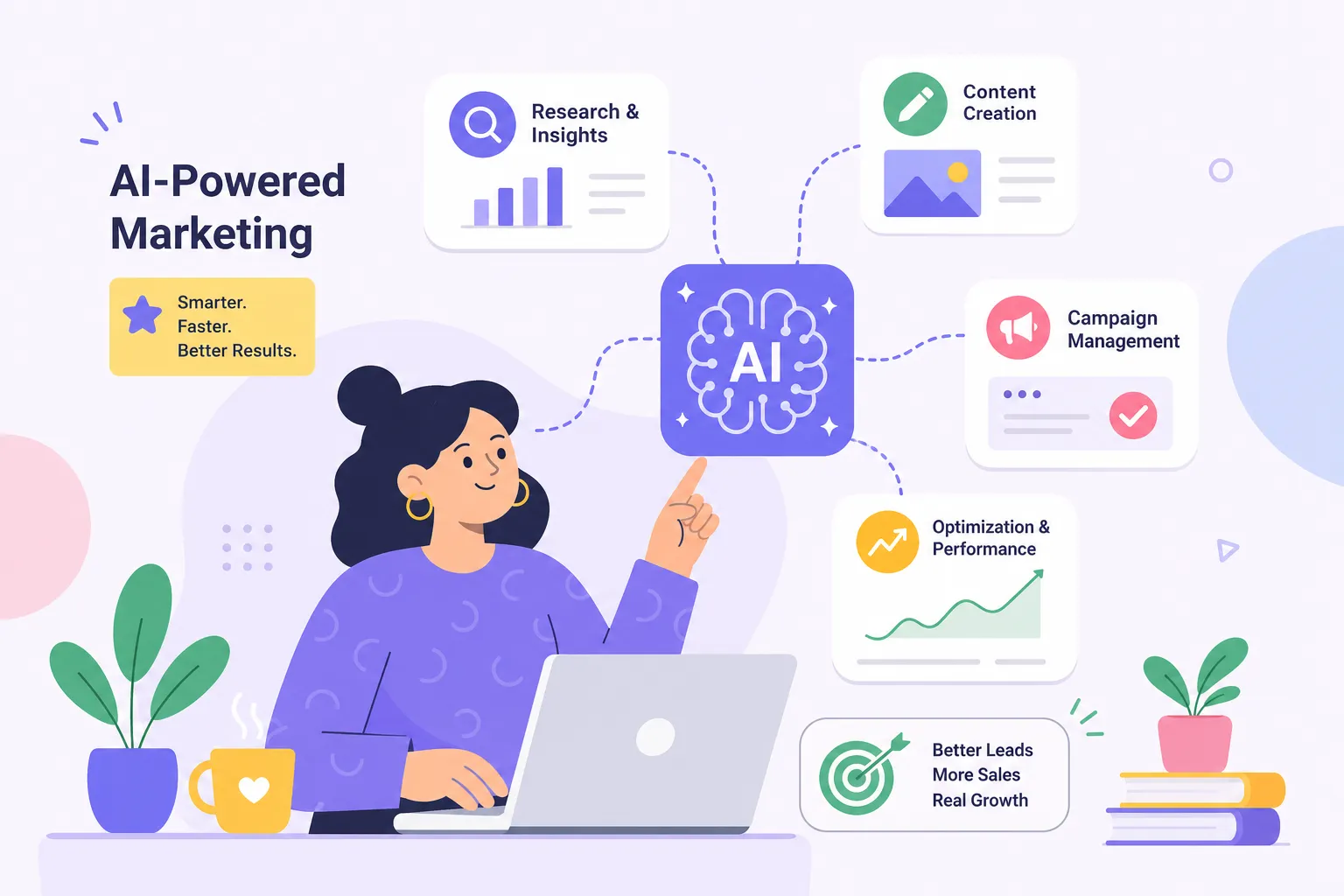
This article gives you a practical framework for evaluating what you are actually buying. The three capabilities that define a genuine AI marketing agency are AI-powered ad optimisation, content intelligence, and generative search visibility. Most agencies do not offer all three, and this guide will help you tell the difference before you sign anything.
What separates a real AI marketing agency from one that just uses AI tools
Using ChatGPT to draft copy or Canva AI to generate graphics does not make an agency AI-powered. These are productivity shortcuts, and while they save time, they do not change how decisions are made. A genuine AI marketing agency builds its methodology around machine learning outputs, automated optimisation loops, and real-time data signals. The difference is not which software is installed; it is how the agency thinks and where the intelligence sits in the workflow.
The distinction becomes clear when you look at where decisions actually happen. Traditional agencies review campaigns weekly, adjust bids manually, and publish content based on instinct or editorial calendars. An AI-embedded agency makes bidding decisions in milliseconds based on live performance data, tests dozens of creative variants simultaneously, and plans content based on predictive demand signals rather than gut feel. That gap in speed and precision is what drives the outcome differences you see in published performance data.
When you speak to an agency, the question to ask is not “do you use AI?” Almost everyone will say yes. The sharper question is: “Which decisions in our campaign does AI make, and who reviews them?” If they cannot give a specific, process-level answer, you are looking at a traditional agency with new terminology rather than a fundamentally different operating model.
The three core capabilities to expect from an AI marketing agency in 2026
AI-powered ad optimisation
Leading AI marketing specialists use platforms such as Google’s Performance Max, Meta Advantage+, and programmatic tools including The Trade Desk and Skai to automate bidding, audience targeting, and creative rotation. These systems continuously optimise based on real-time performance signals that no human can process at the same speed or scale. According to Google’s own published performance data, Performance Max can deliver 18% more valuable conversions at a similar cost per action compared with traditional single-channel campaigns. Meta’s internal testing shows Advantage+ produced a 32% drop in cost per acquisition and a 17% increase in ROAS versus manual campaign management in comparable tests.
Speed matters, but the real advantage is that the system keeps learning and adjusting after launch. In one published UK agency case study, outcomes included an 87% reduction in cost per sale and a 40% lower cost per conversion for a specific client engagement, though results vary significantly by sector, budget, and how well the agency has actually configured and monitored the platform. An agency that simply switches Performance Max on and leaves it is not doing AI marketing. An agency that structures its data feeds, creative inputs, and conversion signals correctly to get the best from the system is.
Content intelligence and predictive planning
AI changes content strategy from reactive to predictive. Instead of publishing based on last month’s performance, AI digital agencies using tools like Surfer, Clearscope, and proprietary models can identify what topics will perform before publishing, how to structure content for relevance, and where competitive gaps exist in a given market. This is not about generating more content faster. It is about producing the right content based on demand signals rather than editorial instinct.
The measurable goal is straightforward: close gaps in search visibility and brand authority that reactive content strategies leave open. Agencies with genuine content intelligence capability will show you keyword gap data, topic cluster maps, and before-and-after organic performance figures rather than generic content calendars.
Generative search visibility: the third capability
This is the capability most agencies have not yet built, and it is increasingly important. In 2026, a growing share of business discovery happens through ChatGPT, Gemini, Perplexity, and Google AI Overviews rather than traditional search results. A genuine AI marketing agency should be able to audit how a brand appears across these platforms and take structured steps to improve it. This is distinct from traditional SEO and requires a different methodology, an agency that offers only classic search ranking work is not covering this layer.
Generative search visibility: why it matters and how agencies act on it
When someone asks ChatGPT or Perplexity for a recommended supplier or service provider, the answer draws from structured brand signals, content authority, and platform-specific indexing, not from a ranked list of Google results. Businesses that have invested only in traditional SEO are often invisible in these responses. Traditional SEO still matters and remains a core channel. But generative visibility is a separate, addable layer that most businesses have simply not addressed yet.
A proper generative visibility audit tests how your brand appears when queried across multiple AI platforms. It identifies gaps in brand entity recognition, assesses whether your content is structured in a way that generative models can synthesise accurately, and builds citation and content structures that reinforce how these systems describe your business. UK Creative Ventures (UKCV), a Bristol-based AI marketing agency, offers this as a dedicated AI visibility audit, producing specific, actionable findings that feed directly into content and PR strategy rather than leaving clients with abstract recommendations and no clear next steps.
Agencies measure progress through brand mention rate, citation frequency, share of voice across platforms, and whether the brand is described accurately and positively when it does appear. The process involves building a fixed prompt set around target topics, running those prompts repeatedly across ChatGPT, Gemini, and Perplexity, and tracking results over time. It is observational rather than algorithmic, but it produces reliable, comparable data that can guide strategy across reporting periods.
How to evaluate an AI marketing agency's genuine expertise
The fastest way to separate genuine AI marketing consultants from tool-users is to ask for documented outcomes, not testimonials, but actual metrics tied to specific AI-driven work with a named starting point and a timeframe. Ask for ROAS improvements from automated bidding, CAC reductions from AI-driven targeting, or content performance data from predictive planning. Benchmarks from published UK agency data suggest figures such as 28% higher ROAS and 54% lower CAC within six months are achievable in strong-performing engagements, according to platform-level case studies published by Google and Meta respectively, though results vary significantly by sector and budget. If an agency cannot point to comparable figures and explain the context behind them, the methodology is likely superficial.
Check sector and client-size fit before anything else. An agency with strong FMCG and B2C case studies may not be the right fit for a B2B SaaS company, even if its AI credentials are solid. Many UK AI marketing companies skew towards enterprise and upper mid-market; agencies built for SMEs and scaling businesses operate differently, price accordingly, and structure their reporting around the metrics that actually matter at that stage of growth.
Watch for these red flags: no documented campaign metrics; reliance on tool name-dropping rather than methodology explanation; no mention of generative search visibility; and an inability to explain where human judgement sits within their automated processes. Any agency that cannot answer “what does your AI actually decide, and who reviews it?” is not operating a genuine AI system, it is running standard marketing work with a few AI tools open in another tab.
What UK AI marketing agencies typically charge
UK AI marketing agency retainers for SMEs sit in three broad bands. Starter or lighter-touch packages typically run from £500 to £1,500 per month, covering tool-assisted execution with limited strategic input. Mid-tier ongoing management sits at £1,500 to £3,500 per month, where you should expect structured reporting, campaign optimisation, and some content intelligence. Broader AI-enabled full-service work runs from £3,000 to £5,000 per month, and at this level you should expect integrated AI ad management, content planning, and generative visibility work as standard rather than optional extras.
Project-based work for smaller implementations ranges from roughly £2,000 to £25,000 depending on scope. Enterprise retainers start materially higher, usually from £10,000 per month upward, with major transformation projects reaching considerably beyond that. If an agency is charging full-service retainer rates but cannot demonstrate the three core capabilities, the pricing is not justified. These are market ranges rather than guarantees; scope, channel mix, and the agency’s genuine depth all drive significant variation. Use pricing as an initial filter, but verify capability before committing.
A practical reality check: at the lower end of the market, most of the “AI” is tool-assisted execution with limited strategic input and minimal reporting depth. At the mid-tier, expect structured monthly reporting, active campaign optimisation, and some predictive content planning. At the higher end, bidding automation, content intelligence, and generative visibility should all be present and measurable. If they are not, you are paying premium rates for a mid-tier service.
Choosing the right AI marketing partner for your business
Build your shortlist by verifying AI methodology over tool claims, checking sector and client-size fit, confirming generative search visibility is part of the offer, and asking for documented outcomes before any commitment. Three to five agencies is a practical shortlist size; beyond that, the evaluation process becomes unwieldy and comparisons lose their clarity. Brief each agency with the same set of questions and assess not just what they say they can do, but how specifically and confidently they explain their process and the evidence behind it
For scaling SMEs, managing separate vendors for marketing, AI visibility, and recruitment creates coordination overhead and gaps in strategy alignment. An agency that integrates these functions under one roof removes that friction. UK Creative Ventures (UKCV) is built specifically for this scenario: a Bristol-based AI advertising agency combining AI-powered ad optimisation, generative search visibility audits, and specialist recruitment under a single growth partner model. For businesses that want fewer vendor relationships and tighter alignment between marketing and hiring, it is worth including in any serious shortlist evaluation.
The bottom line: what you are actually buying
The honest answer to the question in this title is that it depends entirely on which agency you ask. The best ones have embedded AI into their methodology at the bidding, content, and generative visibility layer, and they can show you exactly how. The rest are traditional agencies with new tools and updated branding, and the pitch sounds identical from the outside.
Use the framework from this article to tell them apart. Verify the three core capabilities, AI-powered ad optimisation, content intelligence, and generative search visibility, ask for documented outcomes with real numbers, check sector fit, and probe the methodology before any commitment. The questions are straightforward; a genuine AI marketing agency will answer them without hesitation.
Choosing the right partner comes down to evidence, not promises. If you want a UK AI marketing agency that covers all three capabilities without requiring multiple vendor relationships, UKCV offers a free initial consultation covering your current AI visibility gaps, campaign optimisation approach, and growth priorities. It is worth a conversation before you finalise your shortlist
Tags: