

-
2342 Views
AI visibility optimisation, sometimes called AEO (AI experience optimisation), focuses on whether AI systems pull your brand name, content, or website into their answers at all.
UKCV
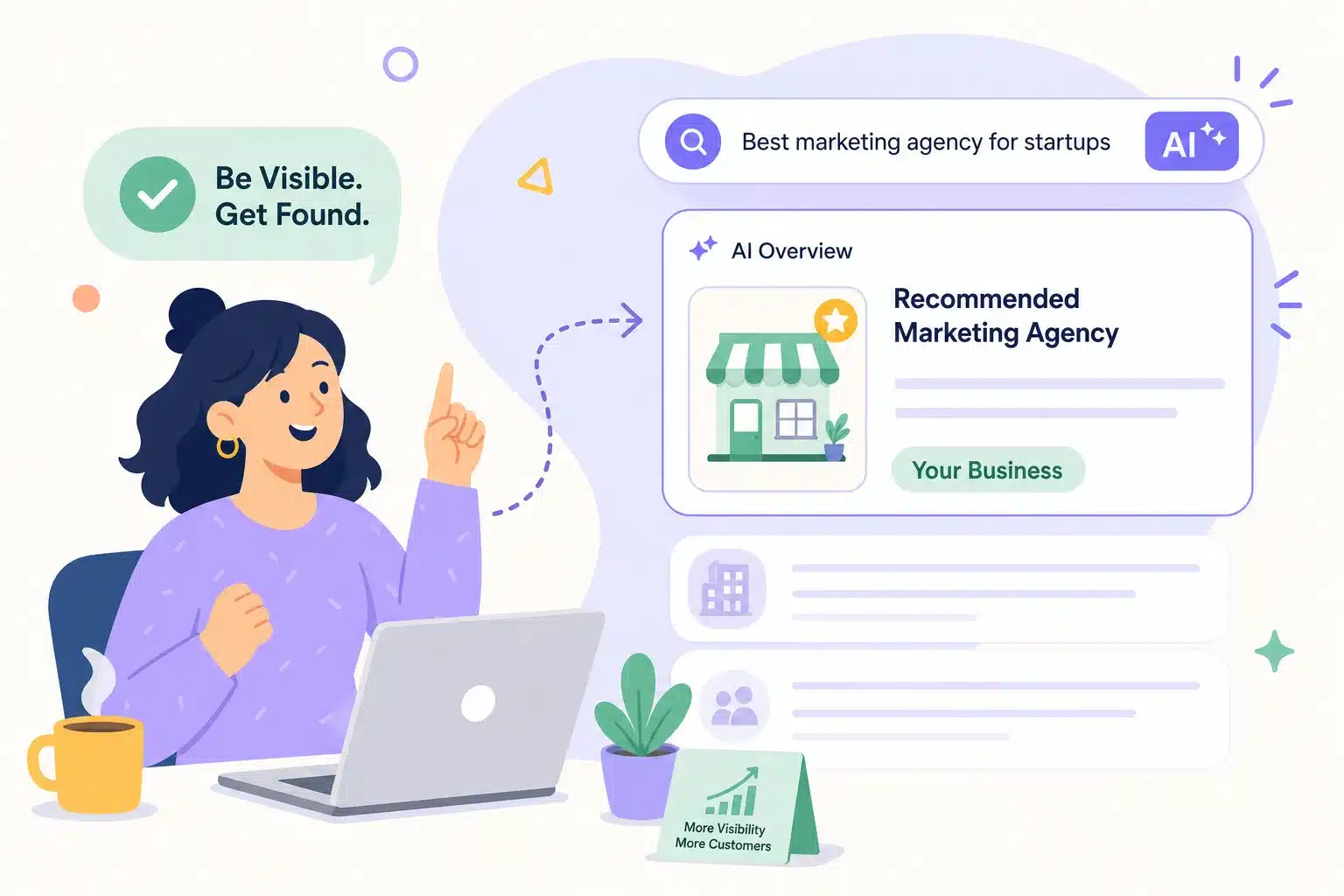
Picture this: a potential customer opens ChatGPT and types “best marketing agency in Bristol” or “who should I use for specialist recruitment in the UK?” A competitor gets named directly in the answer. Your business does not appear at all. That customer never visits your website. They never see your case studies, your pricing, your reviews. The buying decision is effectively made before you even entered the picture.
So what is AI visibility, and why does it matter for small businesses right now? At its core, it is how often your brand appears in AI-generated answers, and the gap between businesses that appear and those that do not is already costing real customers. According to recent UK consumer research, 51% of people now use AI search tools to find products, services, and advice, with 40% doing so at least once daily. When we start working with a new client at UK Creative Ventures, one of the first questions we ask is whether they appear in AI-generated answers at all. In our experience, the answer is almost always no, and that gap is costing them customers they never even knew they lost.
Understanding what AI visibility means, how it works, and what you can do about it is the first step to changing that. This article covers all three.
What is AI visibility and why does it matter for small businesses?
From ten blue links to AI-generated answers
Traditional Google search returned a list of links. You ranked, users clicked, traffic arrived. That model still exists, but it is no longer the only one that matters. Generative AI platforms like ChatGPT, Perplexity, and Google AI Overviews do something structurally different: they generate a direct answer, pulling from multiple sources, and present it to the user as a synthesised response. Your website link may never appear. The user gets the information they need without visiting anyone’s site, or they visit one of the small number of sources the AI chose to cite.
AI visibility refers to how often your business is mentioned, cited, or recommended within those AI-generated responses. It is a distinct metric from your SEO ranking position, and it requires a different approach to improve. Think of it this way: ranking on page one of Google and being cited in an AI-generated answer are two separate outcomes that need separate strategies.
Why it is different from traditional SEO
Traditional SEO optimises for where you appear on a search engine results page. AI visibility optimisation, sometimes called AEO (AI experience optimisation), focuses on whether AI systems pull your brand name, content, or website into their answers at all. A business can sit on page one of Google and still be entirely absent from AI-sourced answers. Both matter in 2026, and survey data suggests many small businesses are still focused primarily on traditional search rankings without yet addressing the AI discoverability gap alongside it.
The platforms that matter most right now
For most small businesses, AI discoverability plays out across three primary surfaces. ChatGPT synthesises answers from its training data and live browsing, drawing on what it has learned about your brand and what it can retrieve in real time. Perplexity retrieves and cites live sources more explicitly, often showing clear AI citations and recommendations alongside its answers. Google AI Overviews surface summarised answers at the very top of search results, before any organic links appear. Each platform applies a slightly different selection logic, but the underlying signals that help a business get cited overlap significantly across all three.
How AI platforms decide which businesses to cite
Authority and trust signals
AI systems do not surface businesses at random. They draw on a combination of what is in their training data, what they can retrieve via live search, and how credible the source appears. A brand that appears across industry publications, review platforms, and trusted directories is far more likely to be included in an AI-generated answer than one that exists only on its own website. The number and quality of reputable sites that mention or link to your business play a significant role in whether AI systems treat you as a credible entity worth recommending.
Content clarity and answer-readiness
AI systems prefer content that directly answers questions. Pages built around long paragraphs of promotional copy are harder for AI to extract useful information from. Content structured around clear questions, concise definitions, and factual statements is more likely to be pulled into AI-generated responses. This is the practical logic behind answer-first page structures and FAQ-style content: if your page answers a question clearly and completely, an AI system is more likely to use it as a source.
Schema markup accelerates this further. Practitioner analyses and platform documentation consistently highlight FAQPage schema as increasing the likelihood of appearing in AI-generated answers, though it works best when it genuinely matches the page’s content rather than being bolted on as a standalone fix. Organisation and Person schema help AI systems identify your brand as a coherent entity, while HowTo schema improves AI answer attribution for procedural or instructional content.
Consistency across the web
If your business name, description, and category appear differently across your website, Google Business Profile, LinkedIn, and third-party directories, AI systems struggle to recognise your brand as a single, coherent entity. Consistent entity signals, your name, description, and contact details presented identically across every platform, strengthen your AI-driven search presence. Every inconsistency creates doubt in how AI systems categorise and reference you.
Why small businesses are already losing customers over this
The visibility gap between cited and uncited competitors
When a user asks ChatGPT to recommend an accountant, a solicitor, a marketing agency, or a tradesperson in their area, the businesses cited in that answer receive an implicit endorsement. Practitioner analyses, including agency and vendor reporting from 2025 and 2026, suggest cited brands see meaningfully higher organic click volumes than non-cited competitors, with some analyses reporting a 23% uplift in non-branded organic clicks for cited pages. It is worth noting that much of this data comes from agency case studies rather than large independent datasets, but the directional signal is consistent: AI citations and recommendations carry commercial weight. If your competitor is named and you are not, the buying decision may already be made before your website is even considered.
How buyer behaviour is shifting in 2026
More consumers and business buyers are beginning their search journey on AI platforms rather than traditional search engines, particularly for advice-based or recommendation queries. This is not a distant trend, it is visible in referral data right now for businesses that are tracking it. Early AI referral tracking from agency and vendor sources indicates that AI-referred visitors tend to convert at meaningfully higher rates than standard organic visitors, with some reported ranges of two to five times higher for traffic arriving via AI-sourced answers; these figures vary widely and should be treated as directional rather than definitive. Small businesses that treat AI visibility as something to address later are ceding ground to competitors who are already taking it seriously.
Metrics to measure your AI search visibility
Mention rate and citation rate
Mention rate is the percentage of relevant prompts where your brand appears in an AI response. Citation rate narrows this to appearances that include a traceable link or direct reference to your content. Both are tracked by running a consistent set of test prompts across platforms. There are no universal benchmarks for small businesses yet; the most useful target is an improving trend over time, alongside a growing share of mentions relative to your direct competitors.
Share of voice and prompt coverage
Share of voice measures your brand’s proportion of total mentions across a defined prompt set that includes your competitors. Prompt coverage tracks how many of your priority questions produce at least one brand appearance. Together, these two metrics give a clearer picture than any single number. A business with low prompt coverage has an obvious content gap; a business with low share of voice likely has an authority or consistency problem. Addressing both requires different actions, which is why measuring them separately is worthwhile.
AI referral traffic as a downstream signal
Google Analytics 4 allows you to isolate traffic arriving from AI platforms by monitoring referral source strings associated with ChatGPT, Perplexity, and similar tools. Tracking this channel, and the conversion behaviour of that traffic, tells you whether your AI citations are translating into real business outcomes. Businesses that begin tracking this early build a useful baseline before the channel becomes mainstream, making it easier to attribute the return on any AI visibility work over time. As a recommended practice, if you are not measuring it now, you will have no point of comparison once AI referral traffic becomes a significant share of your mix.
Practical steps to improve your AI search presence
On-site changes that help AI systems parse your content
Start with page structure. Put the core answer or definition near the top of any informational page, use clear question-based subheadings, and add FAQ sections where relevant. Implement schema markup: Organisation and Person schema help AI systems identify your brand as a coherent entity; FAQPage and HowTo schema improve the chances of your content being used in AI-generated answers. Ensure your key pages are fully crawlable and not blocked by technical issues that would prevent AI systems from accessing them.
Off-site moves that build authority and trust
Claim and fully complete your Google Business Profile, keeping your name, description, and category identical to how they appear on your website. Actively seek reviews on Google, Trustpilot, and any sector-specific platform where your customers look. Pursue mentions from reputable sources: industry publications, local business press, podcast appearances, and expert commentary all strengthen the off-site signals that AI systems use when deciding whose content to surface. The underlying principle is consistency, every mention of your business across the web should reinforce the same entity. A handful of high-quality, genuinely earned mentions tends to do more for AI visibility optimisation than a large volume of low-authority directory listings.
A practical starting point for most small businesses
Before running any tactics, establish your current baseline. Pick ten to fifteen questions your ideal customer might ask an AI platform, questions that relate to your product, service, or sector, and test them manually across ChatGPT, Perplexity, and Google AI Overviews. Record whether your business is cited, mentioned, or absent. In our experience, this audit typically takes around an hour and immediately shows you where the gaps are. It is the most valuable diagnostic step a small business can take right now, and it costs nothing.
When to get a proper AI visibility audit
Signs that DIY is not enough
If your manual tests return consistently blank results across all three platforms, you operate in a competitive local or specialist market, or you have already invested in SEO and content without seeing any AI citation results, the issue is likely more structural than a quick page edit can fix. The problem could be entity inconsistency, a content gap around specific query types, weak off-site authority, or technical crawlability issues. Identifying the actual bottleneck requires a more systematic process than manual spot-checking alone can provide.
What an AI visibility audit covers
A proper audit tests your brand across a representative set of prompts, maps your current citation rate and share of voice against competitors, identifies content and technical gaps, and produces a prioritised action plan. At UK Creative Ventures, this is typically the starting point for any client where AI search is part of the brief. It gives the client and agency a factual picture of where the business stands before any work begins. For a small business without internal marketing resource, it converts an abstract concern into a concrete to-do list, with the highest-impact actions clearly ranked.
The bottom line
What is AI visibility and why does it matter for small businesses? Put simply: it is how often your brand is cited or recommended in AI-generated answers, and it is already influencing buying decisions. It requires different tactics from traditional SEO, and the businesses building a durable presence on AI platforms are those that establish authority consistently, structure their content for AI systems to extract, and start measuring now rather than later.
The first step is understanding where you currently stand. Run your manual prompt audit this week. If the results are thin or nonexistent, work through the on-site and off-site fundamentals: cleaner page structure, schema markup, consistent entity signals, and a steady flow of credible off-site mentions. The path to improved AI discoverability is methodical. It rewards consistency more than complexity.
If you would rather get a clear, structured picture of exactly where your business stands and what to fix first, UK Creative Ventures offers AI visibility audits for small businesses ready to move from guesswork to a proper plan. Find out more at ukcreativeventures.com.
Tags: