

-
2348 Views
Businesses that are well-represented now, with consistent, accurate, and authoritative information across the web, are building a structural advantage as AI search continues to grow.
UKCV
Does ChatGPT replace Google for finding businesses? That question is now genuinely worth asking. Forty-five per cent of UK consumers used an AI tool to find a local business in the past year, a figure that jumped from just 6% in 2025, according to BrightLocal’s 2026 Local Consumer Search Survey. The behaviour shift is not gradual; it is already underway. And yet 97% of those same AI users still double-check the results before acting on them. That tension tells you everything you need to know about where we are right now.
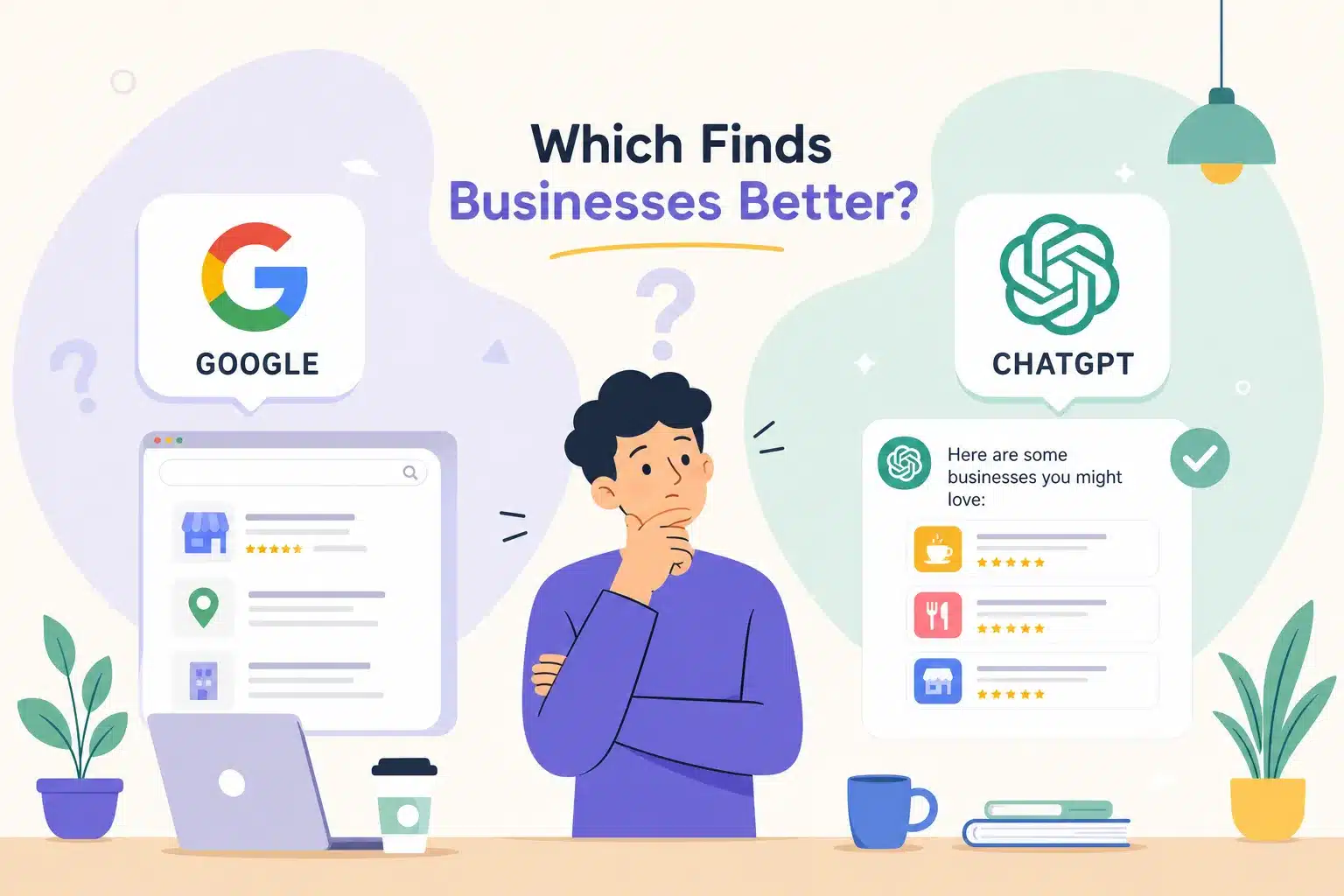
ChatGPT and Google are not doing the same job, even when the output looks similar on screen. One is a live business directory connected to verified listings and device location. The other is a conversational research assistant that synthesises information from across the web. For consumers, that distinction changes which tool to reach for and when. For business owners, it raises a harder question: what happens when ChatGPT either does not mention your business or gets your details wrong? At UK Creative Ventures, we run AI visibility audits for UK businesses, and the gap between how a company appears on Google and how it appears on generative AI platforms is consistently one of the most eye-opening things we show clients.
How each platform actually surfaces business information
Google Search and Google Maps are built on two connected but distinct systems. The first is a continuously crawled web index that ranks publicly available pages. The second is a verified local business listing database, powered by Google Business Profile, where owners claim, verify, and update their own entries. When you search for a plumber in Bristol, the local results you see come from that listing database, updated through business verification, user edits, and owner-managed changes. It is a near-real-time system designed specifically to surface business facts reliably.
ChatGPT works very differently. By default, it answers from its training data, which has a knowledge cut-off. When ChatGPT Search or Deep Research is enabled, it queries Bing-powered web results and synthesises the top sources into a response, as documented in OpenAI’s product guidance for ChatGPT Search. It does not tap a proprietary local listing database. For local queries, it assembles details from third-party sources such as Foursquare, Yelp, and TripAdvisor, along with whatever the business’s own website makes publicly accessible. Coverage is uneven, and freshness depends entirely on whether the user triggered a live search or whether the model is drawing on older training data.
There is also a geolocation gap that most people do not notice. ChatGPT does not use your device location the way Google Maps does. “Near me” queries require you to specify a town or city, because ChatGPT has no native spatial awareness. It cannot rank results by proximity or offer turn-by-turn directions from your current position. For genuinely local discovery, this is a meaningful limitation that Google Maps still solves far better, making the question of whether ChatGPT replaces Google for finding businesses particularly acute at the hyperlocal level.
The hallucination problem: what AI business listing data actually shows
The accuracy problem with AI business listings is more serious than most people assume. Across more than 13,000 queries to ChatGPT, Perplexity, and Gemini focused on London-based businesses, 93% of businesses had at least one basic fact hallucinated or missing, a finding from a large-scale AI local business finder audit published in early 2026. Wrong phone numbers were the most frequent error, followed by incorrect addresses and outdated business names. These are not edge cases. They represent the norm in large-scale testing of ChatGPT hallucination in business listings, and they should fundamentally change how much you trust an AI-generated listing without verification.
Smaller and newer businesses are most exposed to this problem. ChatGPT’s accuracy for any given business is largely a function of how much reliable, consistent information exists about that business across the public web. Large brands with strong structured data, press coverage, and high-authority backlinks tend to be represented more accurately. A Bristol-based independent restaurant or a recently launched specialist consultancy is far more likely to be misrepresented, omitted, or invented entirely. It is worth noting that some of these gaps are structural, inherent in how language models synthesise publicly available sources rather than query verified databases, while others may narrow over time as AI platforms integrate richer directory and retrieval connections.
Consumers are instinctively cautious. Eighty-eight per cent of AI users say they verify sources or legitimacy before acting on AI recommendations. That instinct limits some of the harm. But a wrong phone number or outdated address still costs a business a customer, even if that customer eventually finds the correct details elsewhere. The damage is real, even when it is indirect.
Where ChatGPT and Google differ for finding businesses: synthesis vs. retrieval
ChatGPT’s strength is synthesis, not retrieval. When a consumer or B2B buyer wants to compare three accountancy firms, understand the difference between two service models, or get a narrative summary of what a supplier actually does, ChatGPT can build a coherent answer from multiple sources faster than scanning ten separate Google results pages. For early-stage research, shortlisting, and understanding options, user experience data and usability studies consistently suggest it can offer a more integrated starting point than Google’s link-list format, though Google remains stronger once a user needs specific, verifiable facts.
This is especially true for B2B procurement. A 2026 Magenta survey of UK senior decision-makers found that 66% of those with B2B buying power use AI tools to research and evaluate suppliers, and 90% of those users trust the recommendations enough to act on them. The typical pattern is to describe a business problem rather than type a brand name, let the AI suggest three to five relevant vendors with brief rationale, and then validate those suggestions through websites, reviews, and direct enquiries. AI is acting as a first-pass filter, not the final decision-maker. For businesses that want to be shortlisted, that distinction matters enormously.
For hours, directions, phone numbers, current reviews, and anything requiring a geographically precise result, Google Maps is still the stronger tool. For finding whether a business is currently active, visible online, and ranking for its own name, Google Search remains the more reliable first check. The two tools are not competitors so much as different instruments for different stages of the same research process.
How to verify AI-generated business details before you act on them
The most reliable approach when you need to verify business details online is a three-source cross-check. Start with the business’s Google Business Profile or Maps listing for address, hours, and phone number. Compare that against the business’s official website contact page. Then check one independent directory or review platform for consistency. If all three match, the detail is almost certainly correct. If any source differs, treat the discrepancy as a flag and go to the primary source, usually the business website or a direct phone call.
How you phrase a ChatGPT query also affects the quality of output. Asking ChatGPT to “search for the current website and contact details for [business name] in [city]” prompts a live web search rather than a training-data answer, as ChatGPT Search retrieves and cites live sources when explicitly prompted to do so. Asking it to cite sources for any business details it provides means you can check those sources directly. Treat ChatGPT as a research assistant rather than a directory, and verify its outputs against primary sources before acting on them.
Three targeted searches address the most common error categories in under two minutes. Search the exact business name plus “contact” or “hours” in Google. Search the phone number in quotes to confirm it belongs to the right business. Search the full address in quotes to confirm it is not assigned to a different entity. These patterns eliminate the most frequent categories of AI error before they cause a problem.
What businesses risk when they are invisible on AI platforms
ChatGPT does not have an ad auction or a ranking algorithm in the way Google does. Its tendency to mention a particular business comes from the volume, consistency, and quality of information about that business across the sources it has been trained on or can retrieve: press coverage, structured data on the business website, reviews across multiple platforms, citations from authoritative sites, and direct mentions in industry content. A business with a weak digital footprint does not just rank lower; it may not appear at all, or it may be represented inaccurately because the model is filling gaps with inference.
Most business owners have optimised for Google. Some have thought seriously about SEO. Very few have tested how they appear on ChatGPT, Perplexity, Gemini, or Google AI Overviews. That gap creates a real risk of lost customers among the growing share of consumers and B2B buyers who now start their search journey on AI platforms, a risk supported by conversion data showing that inaccurate or absent listings directly reduce lead rates. One practical starting point is an AI visibility audit, which tests how a business currently appears across generative AI platforms and identifies whether the information surfaced is accurate, incomplete, or missing entirely. At UK Creative Ventures, this is the diagnostic we run before recommending any fixes, because the gap between what a business thinks it looks like on AI and what actually appears is almost always larger than expected.
AI search is not a future trend to monitor. It is already shaping how a meaningful share of consumers and B2B buyers discover and evaluate businesses. Businesses that are well-represented now, with consistent, accurate, and authoritative information across the web, are building a structural advantage as AI search continues to grow. The signals that drive AI visibility, clear entity information, consistent details across sources, substantive third-party mentions, and structured content, are not separate from good SEO practice. They are an extension of it. Waiting to see how AI search evolves means starting from a deficit when the time comes to act.
Does ChatGPT replace Google for finding businesses? The verdict.
ChatGPT is not replacing Google for finding businesses. What it is doing is becoming a parallel channel that millions of people already use, one that handles discovery tasks differently enough that ignoring it carries real commercial risk. For consumers, use each tool for what it does best: ChatGPT for research, comparison, and understanding options; Google for specific facts, location, hours, and reviews. Always verify specific details against primary sources before acting.
For business owners, the question of whether ChatGPT replaces Google for finding businesses is less important than a more practical one: does your business appear accurately, consistently, and favourably enough to make the shortlist when a potential customer or B2B buyer asks an AI tool for a recommendation? If you are not sure of the answer, that uncertainty is itself useful information.
If you want to understand exactly how your business currently appears across ChatGPT, Perplexity, Gemini, and Google AI Overviews, an AI visibility audit with UK Creative Ventures will give you a clear picture of where the gaps are and what to do about them. We identify what is broken, explain why it matters commercially, and set out the steps to fix it, so you are not waiting to find out the hard way.
Tags: